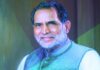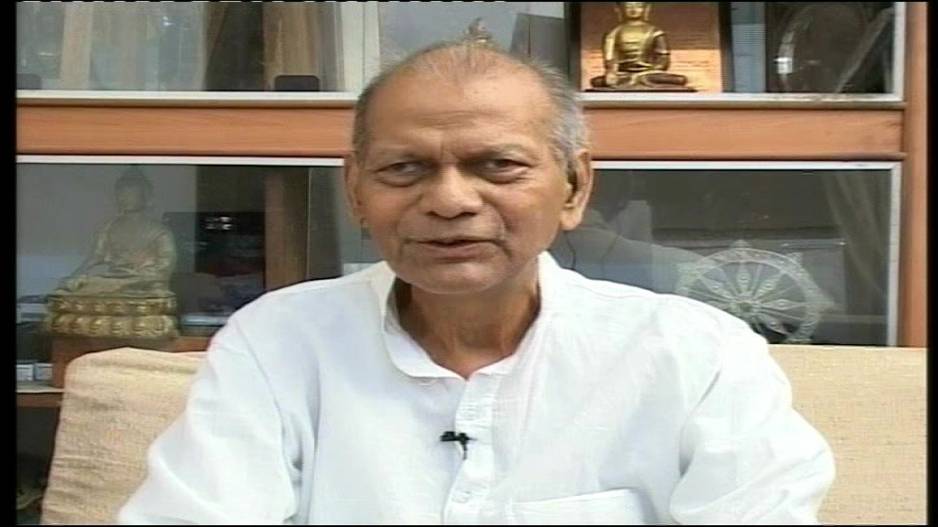

It is a special opportunity for me to share some of my considerations of Rabi Ray whom I consider as one of the most outstanding Socialists of post-independence India. Sri Rabi Ray was introduced to me when I was a very young lad at the age of six or seven years. My uncle was at that time the General Secretary of the Young Socialist League. He told me, “he is also your uncle” and you must call him uncle. From then till today, there has been always an enlargement of his image in my mind from event to event. This did not happen in case of other socialist leaders that I have known since my childhood. I felt some of them were losing their purpose and objectives somewhere along the way in pursuit of power and politics. In case of Rabi Ray one of the most outstanding aspects of his personality has been for me, as a student of politics and sociology, a consistency of commitment and clarity of purpose. I have seen him not only in the national arena. I had the opportunity of visiting some of the districts of Orissa where he was once or twice elected as Member of Parliament and had independent opportunities of knowing about him, from people of Orissa, students, or political activists who did not know him personally.
If I go back in the memory lane, one of the closest associates of Ram Manohar Lohia who became politically active after freedom struggle is Rabiji. He was one of the founders of the Young Socialist League along with very dedicated idealist leaders from various parts of India, particularly Hore Murari, Rangnath, Vijay Kumar, Raj Narain. Then if you go to see his contribution to the Young Socialist League he was picked up by Ram Manohar Lohia to be made one of the joint Secretaries of the Socialist Party which was created after the split in which he opposed the then established leaders like Ashok Mehta, Jai Prakash Narain. Lohia trusted him and it grew in an expected manner because Rabi Ray concentrated on organizational activities without regard to other considerations either in Orissa or elsewhere. Therefore, from 1956 to 1967 he shouldered an unbroken chain of responsibilities in different positions and in different times.
During that period he came to Varanasi a few times. In that period I also grew up from a child to an adolescent and then to a student leader of the BHU. As Rabi Ray had never been a member of Parliament during that time I had limited political contacts with him but over a period of five years he visited our residence many times and endeared himself to all members of the family. He would make it a point to meet my mother and pay his respects to my grandmother. It was a typical way of associating with family members. It was so much unlike the other visitors to our residence who would come to my grandfather, who began his carrier in the non-cooperation movement and came to Kashi Bidhyapeeth. These visitors did not meet other members of the family or mix up with the children of the family. Therefore, with my mother and grandmother he has been one of the favorite young socialist leaders.
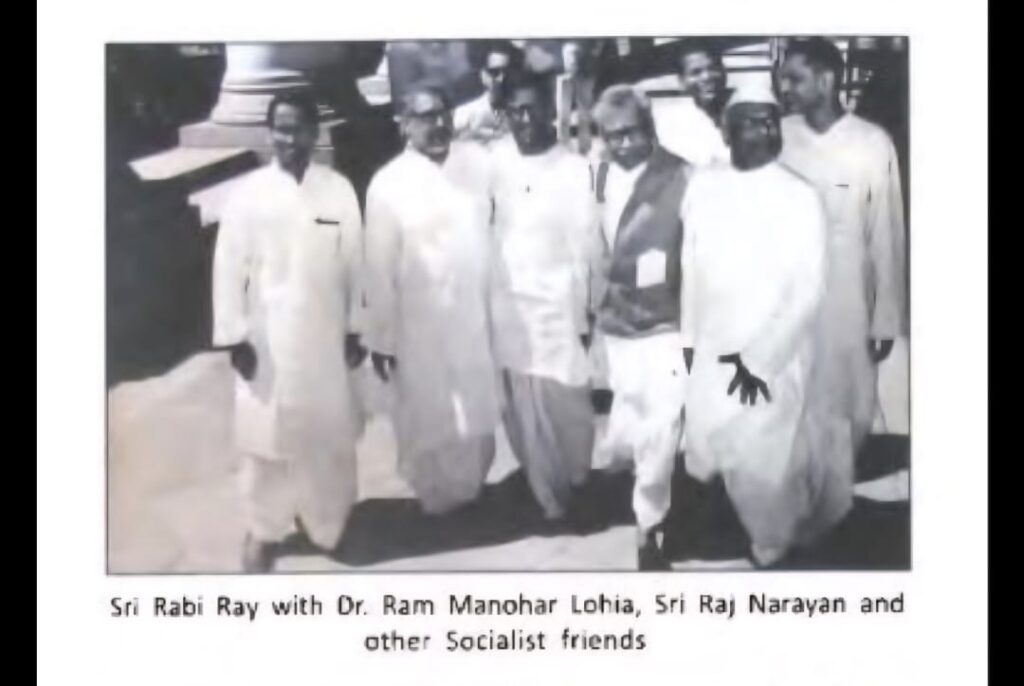
But after 1967 Rabi Ray, from my perspective becomes very very important because he became one of the members of the SSP and a very vocal members of the Lok Sabha along with Ram Manohar Lohia. That was a time of change in national politics and Rabi Ray along with J.H. Patel, Madhu Limaye, George Fernandez served as frontline leaders of alternative political force around the strategy of non- Congressism. He became the architect of Non-Congressism in Orissa politics and took certain pragmatic decisions in pursuit of the strategy of his master, leader and teacher Ram Manohar Lohia. And carried it further after Lohia’s untimely death in Oct, 1967. For me Rabi Ray has another quality and that is his non-controversial personality. Socialists have generally been projected, not very incorrectly, as quarrelsome and egoistic with holier-than-thou attitude. If you look at the band of socialist leaders, this was not a very misplaced assessment of the Socialist leaders of india particularly of Lohia variety. But Rabi Ray was totally dedicated to the tohia line from language policy to the policy of reservations for other sectors but never once he was found to be in controversies related to ego problems, so, whenever socialists were divided Rabi Ray’s would be a sane voice or whenever they would be united he would be a natural choice for leading the party collectively, in the unity or post unity phase. He served as the general Secretary of the SSP and then as one of the General Secretaries of the BLD and then as one of the Secretaries of the Janata Party of 1977.
And then later on when there was a search of a speaker for a very divided lok Sabha, when there was a three party understanding to make Mr. V. P. Singh serve as Prime Minister, Rabi Ray became an obvious choice between the Communists, BJP, ex-Congress people, ex-Janata people and of course, the new Janata Dal. He served with distinction as a Speaker of Lok Sabha and served with equal distinction as a member of Rajya Sabha. He also served with distinction as a member of the Union cabinet in 1977-79.
As to how as a leader of Opposition i.e. SSP, as a member of the parliament, then as a member of union Cabinet, then as Speaker of Lok Sabha and then finally as one of the few national leaders with a conscience in the present times of crisis because of nexus of crime-politics on the one hand and loss of orientation and commitment for a pro-people politics on the other, as Organizational leader of the socialist movement Rabi Ray served with distinction, whether it was a small party or it was a large and ruling party. He was very very straight forward in taking positions in the context of national politics. I remember distinctly that when Jai Prakash Narayan was moving in a very gradual manner towards a total opposition towards a regime led by Indira Gandhi, Rabi Ray, as Socialist Party general secretary, contributed at that time as a catalytic agent through his very sharp, distinct statements on the nature of the crisis at that time. At that time | was very close to Jai Prakashji and once in a while JP’s advisors will be complaining against such a statement by leader of a responsible political party. I remember also JP saying that this statement is a little hard, but it is not incorrect and would not like to contradict. When the unity between propeasants parties was in the process under the leadership of .Ch. Charan Singh, BKD, Socialist Party, Muslim Majlis, Swantantra Party, BJP and parties with very very misleading names but having a common base of middle peasant and middle castes, when they were trying to come together, Rabi Ray was part of that coordination group which ranged from Piloo Modi to George Fernadez, Charan Singh and Balraj
Madhok, on the other hand. He as able associate of Raj Narain at that time facilitated the dialogue between the hardcore socialists who were going by book and the people in general, who were wanting to create a general ambience for a new political thrust of peasantism, peasant politics, and of course Charan Singh, who had not much of liking for socialist rhetoric. I remember Rabi Ray softening the environment and with his personal charms develop a personal rapport with people with diverse. backgrounds and saw to it that they did not develop any inferiority or isolation. He is a great bridge builder that way. As an organizational leader that way I think his role was remarkable by bringing socialists of all variety together including those with very strong Lohia bias and Lohia commitment.
If you look at Rabi Ray as a politician, his parliamentary career was not satisfactory because he could not play the role of the power broker and therefore he could not develop or could not create his vote banks despite the fact that he came from a dominant caste of Orissa. Rabi Ray refused to cash on that identity, for survival. Therefore, Rabi Ray, as a parliamentarian was a great performer, a fine orator, a man who performed with distinction. An electoral personality, knows only winning election, does not know how to lose an election. That way | think, Rabi Ray was a poor person. He did not develop relations with vote mobilisers, with those with money bag whom he could reciprocate their contribution after the elections. One can see Rabi Ray winning only when there was an overall general mood among the people to vote for opposition candidates. He was always representing dissent and opposition in the Parliament. Nobody believed that voting Rabi Ray will bring in any new project, any new industry, or at the individual level a petrol pump, a telephone connection or such benefits. This is generally associated with the vote mediators. So Rabi Ray got elected in 1967, he lost in 1971, again he got elected in 1977, then again he lost in1980 and then in the third wave against corruption in 1989. He refused to contest in the last Lok Sabha election because he found himself in the minority of one person in Orissa politics which was polarised between pro Congress and pro-Janata Dal.
He found both equally unacceptable, because of lack of any commitment to people’s welfare and secondly because of the open encouragement to the crime -politics nexus that made him go for self imposed exile or getting out of parliament without of any kind of party to his liking. I do not know if history will remember him because of this failure or will history remember him for his consistency and clean public life and decision not to win for the sake of winning but to win with a purpose to have a mandate for the people, of the people rather than have a mandate in the name of the people through the crime nexus for certain vested interests. I think that is a failure for a parliamentary leader in the constituency which made him a leader at the national level. He served in different positions and he remains a class in himself when it comes to look at the diseases in the Indian political culture particularly, what is going on in the name of Parliamentary democracy. When we see him as a minister in the post-colonial politics in India he served for a very short time but with distinction.
He was a Health Minister for a year and a half and remained spotless despite serving in a cabinet where more than half the ministers became tainted knowingly or unknowingly. I visited his house often during those days. I saw workers from all walks of life visiting him. His house was open. He was truly a people’s representative. The safest hour to meet him was the breakfast hours and the dinner time. He would be asking in his kitchen to keep lots of tea ready in the morning. There was not much of a spread but a lot of attention and affection was always there. Even in the houses of other Socialists who were in the cabinet then only MPs and MLAs were allowed into the drawing rooms. He also did not shift his household from Cuttack to Delhi and surrounded himself by his young political associates. When he was the Health Minister, he had kept a lot of discretionary funds and a lot of people with major ailments benefitted from that. But he was not encouraging corruption or cooption of political workers. Raj Narain, George Fernandez, Madhu Limaye and Rabi Ray used to consult each other very often. But Rabi Ray was different from these in terms of availability to party workers and common people. I also remember seeing him when the ministry was collapsing.
Somehow I was a visitor in the Parliament and I observed him there. It seemed as if he was being released from a prison because the last few months of the Janata government had become a phase of shamelessness because of hanging on to power, without any purpose. He was very clear that as the government had lost its internal unity, it should not last.
His speakership was one of the most factional phases of the Indian Parliament. He saw three prime ministers coming in and going and it was a situation, where there were a number of opportunities where he had to use his discretion and judgment. I remember the instance when all the members of Parliament of Chander Shekhar and Devi Lal group were sitting in the residence of Mr. Devi Lal, where I was also invited as one of the newly appointed General Secretaries of the then Samajwadi Janata Party to think of the future possibilities. Everybody was sitting in silence because people were waiting for judgment by Rabi Ray and people were making all kinds of guesses. There were all kinds of apprehensions. There was one common thing that prevailed and that is that no one can influence Rabi Ray on material grounds. He can be influenced on ideological grounds, in the name of Lohia and commitment to people but cannot be influenced by one or the other industrial houses. I distinctly remember that V.P.Singh’s government was an object of attack by not only the social forces but by some business houses because of his crusade against corruption. On the other hand once Mr.Chandra Shekhar was brought in as the Prime Minister, he again began to function with normalcy and did not allow any attack on Mr. Chander Shekhar despite his very basic disagreement with the mode through which the government was brought into power.
Sri Rabi Ray as a Speaker will probably be remembered also for initiating an impeachment of a judge of the Supreme Court of India and it was an instance of its own kind. He pushed the case to its logical limit. He used his democratic prerogatives and after a series of rubber stamp speakers the nation felt that there was a speaker who had his own conscience and his own identity. Justice Ramaswami episode is remembered by him as the most shinning chapters of his Speakership. I think if I recall his public and private conversations regarding his speakership, he remembers two instances with great joy one with the child like joy and the other with statesman like sincerity. The child like joy was when he presided over the function of unveiling the portrait of Ram Manohar Lohia, his political Guru. He would tell you with great details as to how he could manage a great deal of people with a variety of ideas to agree to the idea and how in spite of great reluctance on the part of many important people of that time he could create an opportunity of a graceful ceremony for the unveiling of the portrait of that great rebel, a parliamentarian and for him the greatest Socialist, Or. Ram Manohar Lohia. On the other hand as speaker of India he will tell you with fine details how he was pushed around, how he became practically atone and how in spite of hostility from very very powerful sources including that of the Judiciary he could ultimately let the law take its own course and let the parliament assert its authority and supremacy.
Now when t! came to look at Shree Rabi Ray as a national leader in these hours of crisis i.e.in 1990s then I must say he showed exemplary courage. He was turning out to be very idealistic in an hour when his life was practically approaching a conclusive chapter. He was in his seventies and he decided to rebel against the party that was created by many individuals including himself, the JP led by V.P. Singh. He voiced his views against corruption by the ruling party in Orissa and Bihar and decided to lead the process in company of George Fernandez, Shahabuddin, Chanderjit Vaday, Hari Kishore Singh and Nitish Kumar. He again went in for a second rebel. He discovered that in the name of opposing the Janata Dal, the Samata Party was swinging to the rightist direction deciding to have compromises with the BJP. Two revolts have caused what you call institutional power for Rabi Ray.
Today he is without a political party but today he has so much demand on his time because today he is considered as a man who has a conscience. There is no self. He is a model among politicians since for the self has a secondary status. He is incurring a lot of personal losses. Today he is actively engaged in a multidimensional campaign which is on the one hand arguing for swadeshi against the multinational corporations. But he is not a man who is blind to the proposition of swadeshi and therefore he is all the time arguing and dealing with economists, scientists and others. He is looking for an alternative to the present onslaught of the MNCs. He is also in the frontline of struggles against Intellectual Property Rights related laws which are imposing a monopoly of the western countries on the knowledge of the rest of the world. Thereby he has become a leader and
a darling of the scientific community of the country. He is also helping the peoples empowerment struggles in the tribal belt of MP and the swaraj movement led by the Gandhians and therefore in spite of his very dear and personal relationship with parliamentary democracy. He is engaged in a marathon run. He is trying to create a situation where a new wave of politicization takes place and a new public life comes about and there is a strong nation at peace with itself. So he is engaged in so many campaigns from the right to information movement to decentralization. At the moment I am associated with him in two such processes in a very systematic manner and have got an insight into his doing of things, i.e. his methodology, his Politica! style. He is the national president of the India-Tibet Friendship Society launched by his guru in 1950s and patronized by JP and I am its national secretary. I see Rabi Ray speaks without making any criticism of China. He makes that distinction of government and people. He approaches the issue of Tibet in terms of justice to small nationalities. This makes him also speak again and again on the politics of peace in the Asian continent.
In another context, from the national point of view he recently launched a national debate in an article “Where did we Go wrong?”. The timehonoured link between constructive work and parliamentary politics should be restored. He gives last precedence to electoral politics and thinks that politics of resistance has a priority. He is not cynical in his analysis like many others. This has generated much interest. There was a conference of NGOs, political activists, judicial people and writers from different walks of life.
They all came from different parts of the country in response to this article and all decided to launch a new initiative and it is generated a process of self analysis at the national level calling itself ‘Lok Shakti Abhiyan’. He is one of the patrons. I went with him to a tour of Orissa and later on to the tour of UP. I found Rabi Ray calling upon the youth and asking them to think about their duty towards their country. He criticized intellectuals and the political elite for their pragmatism on the one hand and opportunistic silence on the other. He is argued with the national elite and the middle ciasses to abjure from their onward march to consumerism.
He refers to the agony of Katahandi. So Rabi Ray is trying to remind us today that parliament is there but behind it is peoptle’s power and for people’s power we have to see that it is nursed and it is nurtured. For that it needed an element of idealism. At a time when a number of his followers and his subordinates and younger colleagues were in power. He has not jockeying for a place in the circuit of power elite. He has shown a rare self confidence where he could walk out of Parliament and be equally comfortable in the charmed atmosphere of study circles of the 1950s. Actually he feels more comfortable when the audience is more critical rather than when he is surrounded by sycophants. This makes me believe that Rabi Ray is going to be a reference point as ideal type for the young political workers where he stands as person who started from the college union,i.e. Ravenshaw college and reached to the topmost position of Parliamentary democracy i.e. the Speaker without any backing from criminals, moneybags, or casteists.
He had a conviction of a heretical variety, he was a socialist but not a Marxist, he liked Gandhi but through Lohia, he supported people’s movement but not of a populist variety, he always took the socialist core to any kind of political mobilization and still he turned out to be one of the most spotless and one of the most clean politicians of the post-colonial India. That way it is very strange that of all the socialists that I was introduced since my childhood he probably, apart from a few other exceptions like Madhu Limaye, remained spotless. But ! rate him slightly better than Madhu Limaye also because Madhuji retired from active politics partly because of health reasons after 1980 and partly because of political failures. But Rabi Ray never say die personality and that way he represents someone who has courage of conviction about his views without any immediate results.
From that point of view he belongs to the tradition of democratic politicians or Socialist politicians.
I think Rabi Ray has a case where he pursued a long-term success instead of going for a short term one. He was active in Orissa where the socialist movement was only second to Congress. Within the Socialist movement he was in a minority splinter party which had no immediate future. From there he went to do organizational work in Party headquarters and the party was moving from failure to failure from 1956 to 1964. Some how he had the conviction that this was the right path. Politics after Nehru was a politics of change, will be politics of Lohia socialists. He decided to go for a long term success than to go for quick party hoping in pursuit of immediate individual success. In that sense he can be compared with Jyoti Basu, Namboodripal or Atal Bihari Bajpayee.
In the context of Orissa again Rabi Ray will be recognized as someone who was never yielding to the politics of temporary success. He never agreed to the proposal of large scale capital industrialization. He always pursued the politics of peasant oriented policies and programmes. A day will come when there will be a peasant friendly government in Orissa and that day people will remember that there was a leader who used to tell us about small scale irrigation, micro credits, cooperatives, women’s empowerment and peasant orientation of parties.
A democrat is one who believes that people will be arriving at correct conclusions and judgment. The other aspect is to respect dissent and not to be dogmatic hardliner where the dissent or disagreement is worth no attention. RR demonstrated in the 1950s and the 1960s, given a chance people will not respect or accept Congress and therefore he joined Lohia in pursuit of non-Congressism and it paid rich dividends. People were unhappy and their votes were getting divided and in the absence of correct politica! formation their votes were being wasted. So politics of non-Congressism created an opportunity to pursue politics of change.
Similarly during the emergency and the post emergency Rabi Ray was one of those politicians who agreed with mobilization of JP whole heatedly. During the emergency when the elections were announced other ideological colleagues did not see the possibility of the overthrow of Mrs. Gandhi’s regime through elections and wanted to boycott the elections. Rabi Ray was one of the few within the socialist ranks who said given a fair chance people cannot accept dictatorship beca-use people by temperament are trained in this country through the heritage of the national movement to love freedom. Rabi Ray was vindicated on both counts, First, JP movement was a great success. It brought in a new generation of political activists with democratic convictions. Second, emergency was rejected by the people in spite of the fact that the opposition was handicapped, quite a few being still in jail. People voted against the Indira regime. At the level of dissent, Rabi Ray is a great listener. I had the opportunity of serving in various committees where he has been associated, earlier in Socialist movement, then in Lok Dal and again in Janata Party.
Rabi Ray will not occupy the centre stage but he will keep his ears open to others. Therefore, people will not regard it as a final situation. Even in personal meetings and planning programmes he will listen to the most insignificant voices with respect. He will not mind criticism on his face. This is a rare quality that | have found in very few people today.
Discover more from समता मार्ग
Subscribe to get the latest posts sent to your email.