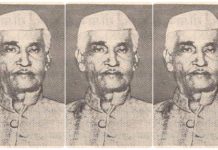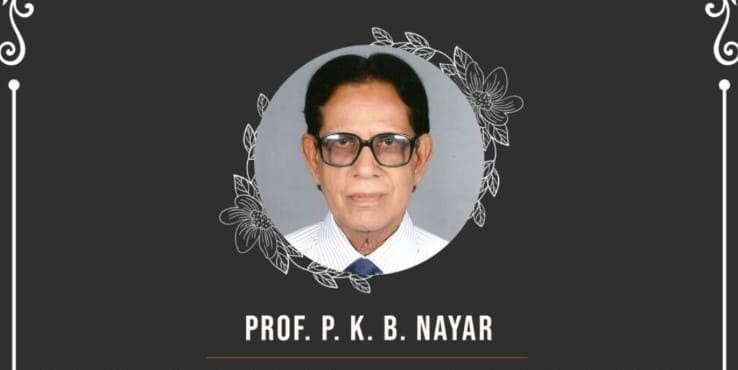
Indian sociology lost one of its most distinguished scholars and institution builders with the passing of Prof. P. K. B. Nayar on 12 February 2026 at Thiruvananthapuram at the age of 96. He died of a cerebral haemorrhage at a hospital in Thiruvananthapuram (Trivandrum), the city that had long been his intellectual home.
Born on 18 December 1929 in Thrikkakara—revered in Kerala’s cultural memory as the legendary capital of Mahabali—Prof. Nayar went on to become one of India’s most respected sociologists and a pioneering gerontologist. Over several decades, he played a foundational role in advancing the sociological study of ageing in India and consistently drew attention to the urgent social, economic, and policy concerns of the elderly.
An exceptionally accomplished scholar, Prof. Nayar earned five Master of Arts degrees—with top distinctions—in Sociology, Economics, Economic Development, Political Science, and History (three from India and two from the United States). He completed his Ph.D. in Sociology at the University of Pittsburgh, USA, in 1966.
Prof. Nayar served the academy with distinction for 42 years as a university teacher, including 22 years as Head of the Department of Sociology at Dibrugarh University and the University of Kerala. At the University of Kerala, he was Dean of the Faculty of Social Sciences, Director of the Centre for Women’s Studies and the Centre for Population Research, and later Chairman of the Thiruvananthapuram-based Centre for Gerontological Studies. He played a pioneering role in strengthening the Sociology Department at Dibrugarh University and contributed significantly to the growth of the discipline both in Kerala and in India’s northeast.
A respected academic leader, he served as President of the Indian Sociological Society (2006–07) and was the founder-President of the Kerala Sociological Society. He was also Chairman of the Kerala State Education Advisory Board and a consultant to international organizations including the FAO, ILO, WHO, and the World Bank. Internationally recognized, he was a Visiting Professor at the University of Paris and a Fulbright Visiting Professor in the United States.
Prof. Nayar’s contributions were widely honoured. Among his many distinctions were the French Government’s Award for Internationally Renowned Scientists (1982), the Fulbright Professor Award (1986), the Golden Award from HelpAge India (2010), the Vayoshreshtha Samman instituted by the Government of India (2014), and Lifetime Achievement Awards from the Kerala Sociological Society (2009), the Indian Sociological Society (2011), and the Indian Association of Social Sciences and Health (2012).
A prolific writer, he authored several influential books and numerous scholarly papers. His major publications include Bureaucracy and Socio-economic Development (1967), Leadership, Bureaucracy and Planning in India: A Sociological Study (1969), Development of Kerala: Problems and Promises (1972), Trivandrum City: Report of a Household Survey (1975), Sociology in India (1980), Widowhood in Modern India (2006), Older Women in India: The Context, Issues, and Concerns (2013), and Elder Abuse and Neglect: The Indian Scenario (2020).
In the field of gerontology, Prof. Nayar was especially known for his critical engagement with ageing policies in India. He observed that despite years of implementation of National and State Policies for Senior Citizens, the elderly had derived limited benefit. He attributed this gap to top-down planning mechanisms in which programmes were imposed through bureaucratic channels. He advocated instead for bottom-up planning rooted in community participation, arguing that meaningful social policy must begin with the lived realities of people.
On a personal note, I had the privilege of several academic interactions with Prof. Nayar in seminars, conferences, and personal meetings. I visited his home in Trivandrum and was struck by his remarkable agility of mind and body, even in advanced age. His clarity of thought and intellectual engagement remained undiminished.
Whenever he invited me to contribute, I wrote articles for the journal of the Kerala Sociological Society, which he edited with dedication and scholarly rigour. We also had the honour of publishing his interview—conducted by Prof. Sobha B. Nair—in the ISS Hindi journal Bhartiya Samajshastra Sameeksa, which I was editing at the time. These collaborations reflected not only his academic stature but also his collegial generosity and encouragement toward fellow scholars.
Prof. Nayar combined intellectual rigour with institutional vision. He was progressive and secular in his outlook on education and public life, and he consistently supported the academic growth of younger colleagues. Those who interacted with him in seminars, conferences, and personal meetings recall his clarity of thought, generosity, and warmth. He remained intellectually agile and deeply engaged with sociological debates well into his later years.
The recent passing of another stalwart, Prof. André Béteille, had already marked a sombre moment for Indian sociology. With the death of Prof. P. K. B. Nayar, the discipline has suffered another profound and irreparable loss. Yet his legacy endures—in his writings, in the institutions he helped shape, and in the continuing work of scholars inspired by his commitment to clarity, intellectual honesty, and socially grounded scholarship.
Discover more from समता मार्ग
Subscribe to get the latest posts sent to your email.