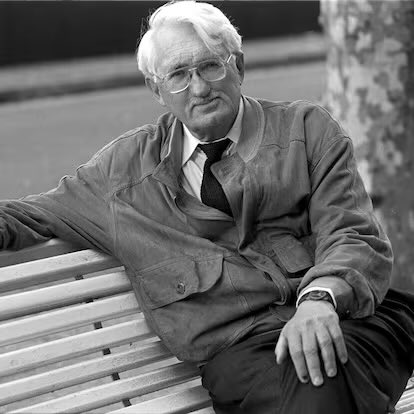
— B K Nagla —
Academic Obituary Introduction
The death of Jürgen Habermas on March 14, 2026 marks the passing of one of the most influential intellectuals in modern social theory. Over more than seven decades, Habermas shaped debates in philosophy, sociology, political theory, and communication studies through his sustained engagement with the normative foundations of democratic life. As the most prominent representative of the second generation of the Frankfurt School, Habermas reoriented critical theory toward the analysis of communication, public discourse, and democratic legitimacy.
His intellectual project can be understood as an effort to reconstruct the emancipatory potential of Enlightenment rationality after the catastrophic experiences of fascism and war in twentieth-century Europe. While earlier critical theorists such as Theodor W. Adorno and Max Horkheimer emphasized the domination of instrumental reason, Habermas argued that rational communication remains a fundamental resource for democratic critique. Through his theory of communicative action and his analysis of the public sphere, he demonstrated that democratic legitimacy ultimately depends on the capacity of citizens to engage in rational and inclusive public discourse.
Intellectual Formation and the Frankfurt School
Habermas was born on June 18, 1929, in Düsseldorf, Germany. His childhood unfolded during the final years of the Weimar Republic and the rise of National Socialism, profoundly influencing his lifelong commitment to democratic accountability. Habermas studied philosophy, sociology, and history at the University of Bonn and became closely associated with the Frankfurt School, a group of scholars combining Marxist theory, sociology, and philosophy to understand the relationship between economic structures, ideology, and political power.
Early Frankfurt School theorists argued that Enlightenment rationality had transformed into instrumental reason serving systems of domination. In works such as Dialectic of Enlightenment, Adorno and Horkheimer described modern societies as increasingly governed by technocratic rationality and mass cultural manipulation. Habermas accepted much of this critique but rejected its deeply pessimistic conclusions, emphasizing that communicative rationality provides a normative foundation for democratic deliberation.
Habermas, Marx, and Weber: A Sociological Synthesis
Habermas’s framework draws on classical sociologists such as Karl Marx and Max Weber, while attempting to overcome their limitations. From Marx, he adopted the critique of capitalist social relations but rejected economic determinism. From Weber, he drew on rationalization and bureaucracy, recognizing that modern societies risk becoming trapped in an “iron cage” of instrumental rationality.
Habermas reformulated these insights through his distinction between system and lifeworld. The system encompasses economic and administrative mechanisms like markets and bureaucracies. The lifeworld refers to shared cultural and communicative backgrounds enabling social understanding. Crises emerge when systemic mechanisms colonize the lifeworld, undermining communicative processes and democratic participation.
Communicative Rationality and Deliberative Democracy
In The Theory of Communicative Action (1981), Habermas developed communicative rationality, reasoning oriented toward mutual understanding rather than strategic success. Everyday communication involves claims about truth, sincerity, and normative legitimacy, which can be justified through rational argument. Democratic legitimacy arises when political decisions emerge from inclusive and rational public debate.
Earlier, in The Structural Transformation of the Public Sphere, Habermas examined the historical emergence of rational-critical debate spaces in 18th-century Europe, arguing that mass media and corporate influence weakened these spaces. Nonetheless, democratic societies must preserve the possibility of open public discourse.
Habermas and Poststructuralist Debate
Habermas’s commitment to Enlightenment rationality brought him into conflict with poststructuralist thinkers such as Michel Foucault, whose analysis emphasized diffuse power networks shaping knowledge and social control. Habermas criticized Foucault for lacking normative foundations for democratic critique, arguing that without rational justification, distinguishing legitimate authority from oppression becomes impossible. This debate reflects the broader tension between Enlightenment universalism and postmodern skepticism.
Decolonial Critiques and Limits of European Universalism
Decolonial scholars such as Enrique Dussel, Walter Mignolo, and Boaventura de Sousa Santos have argued that European modernity cannot be understood without recognizing colonial domination. The historical public sphere described by Habermas was limited to European bourgeois society, often excluding colonial subjects, women, and marginalized groups. Decolonial critiques expand communicative rationality to account for global inequalities of knowledge and power, revealing both the strengths and limitations of Enlightenment-centric frameworks.
Habermas in Global Sociology
Despite these critiques, Habermas’s theory remains influential across the Global South. In India, thinkers like B. R. Ambedkar emphasized constitutional democracy, rational debate, and equality—paralleling Habermas’s ideas of communicative legitimacy. Gandhi’s emphasis on ethical dialogue and nonviolent communication reflects principles analogous to Habermas’s deliberative theory. However, structural inequalities such as caste demonstrate the need to adapt European models to local realities.
In Latin America, decolonial thought critiques Habermas’s Eurocentric conception of modernity while acknowledging the utility of his framework for democratic critique. Transnational public spheres illustrate how his concepts can be applied to global communication, though inequalities in power and access challenge their inclusivity.
System–Lifeworld Model
Lifeworld: Shared cultural norms, values, and language enabling social interaction and communicative action.
System: Economic and administrative institutions operating through instrumental rationality.
Colonization of Lifeworld: Occurs when system mechanisms dominate communication, leading to crises in democratic legitimacy.
Textual Diagram:
Modern Society
│
┌────────────┴────────────┐
│ │
Lifeworld System
(Communication) (Institutions)
│ │
Shared meanings Markets & State
Culture & norms Bureaucracy
Social interaction Economic power
│ │
└────────────┬────────────┘
│
Colonization of Lifeworld
(When system power dominates communication)
│
Crisis of democratic legitimacy
Timeline of Habermas’s Intellectual Development
Period
Development
Key Works
Focus
1950s
Early engagement with critical theory
Doctoral essays
Critique of fascism, Frankfurt School influence
1962
Public sphere theory
The Structural Transformation of the Public Sphere
Historical emergence of rational-critical debate
1970s
Expansion of critical theory
Essays on knowledge
Knowledge, power, social sciences
1981
Communicative action
The Theory of Communicative Action
Communicative rationality, system–lifeworld
1990s
German reunification debates
Political essays
Constitutional patriotism, democratic legitimacy
2000s
Postnational democracy
The Postnational Constellation
European integration, global governance
2000s–2010s
Religion and public sphere
Journal articles
Dialogue between secular and religious reasoning
2020s
Reflections on democracy
Political essays
Defense of deliberative democracy amid global crises
Habermas and the Future of Social Theory
Habermas’s work illustrates the enduring potential and limits of Enlightenment rationality. His emphasis on communicative deliberation provides a normative foundation for democracy, yet global and postcolonial contexts reveal the necessity of accounting for historical inequalities. Integrating decolonial perspectives allows scholars to expand the public sphere and democratize communicative processes. The challenge for contemporary sociology is to preserve the emancipatory potential of Habermas’s insights while adapting them to diverse social realities.
Ultimately, Habermas’s intellectual legacy lies in demonstrating that democratic legitimacy depends not only on institutions but on rational, inclusive public discourse. In an era of global inequality, polarization, and conflict, this principle remains central to the continued evolution of social theory.
References
Dussel, E. (1998). Ethics of liberation in the age of globalization and exclusion. Duke University Press.
Felsch, P. (2024). The philosopher: A biography of Jürgen Habermas. Polity Press.
Habermas, J. (1984). The theory of communicative action: Vol. 1. Beacon Press.
Habermas, J. (1987). The theory of communicative action: Vol. 2. Beacon Press.
Habermas, J. (1989). The structural transformation of the public sphere. MIT Press.
Habermas, J. (2001). The postnational constellation. MIT Press.
Habermas, J. (2006). Religion in the public sphere. European Journal of Philosophy, 14(1), 1–25.
Mignolo, W. (2011). The darker side of western modernity: Global futures, decolonial options. Duke University Press.
Discover more from समता मार्ग
Subscribe to get the latest posts sent to your email.