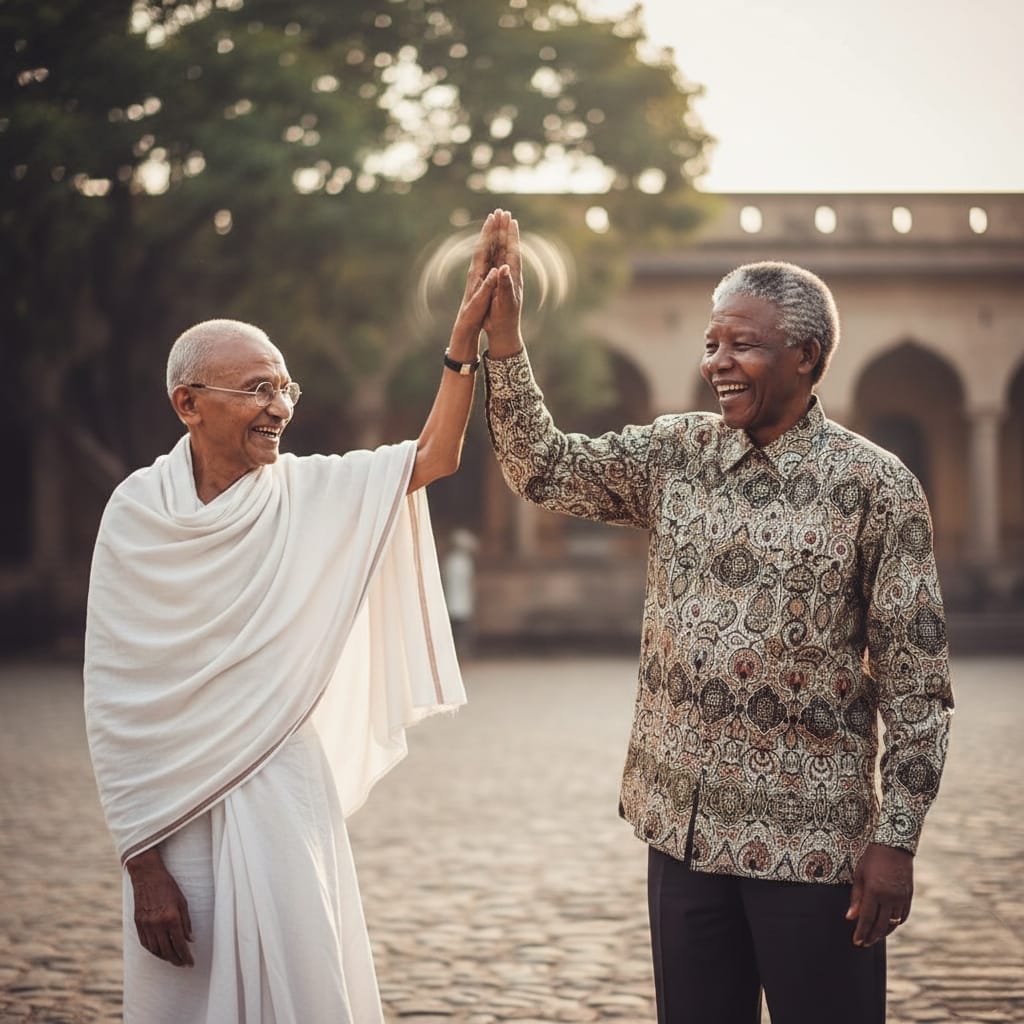
On December 5 it was a dozen years since Nelson Rolihlahla Mandela died. In much of the world, particularly in the USA and Europe, Mandela was hailed as another Gandhi. Like everyone else on this planet, I too mourned Nelson Rolihlahla Mandela. There can be little disputing that he was the greatest man of our times. But Nelson Mandela is being equated with Gandhi, and by many people who should know better, was a bit too much to stomach. Nothing could be more misplaced. They were two very different people. The closest Gandhi went to war was as the founder of the Natal Indian Ambulance Corps, a group of volunteers who served as stretcher-bearers during the second Boer War in South Africa.
Nelson Mandela was the founder of the Umkhonto we Sizwe (Spear of the Nation), the military arm of the African National Congress. Mandela has said that Fidel Castro’s July 26 movement inspired him. The Umkhonto was founded in 1961 after the Sharpeville massacre. Explaining this Mandela wrote: “At the beginning of June 1961, after a long and anxious assessment of the South African situation, I, and some colleagues, came to the conclusion that as violence in this country was inevitable, it would be unrealistic and wrong for African leaders to continue preaching peace and non-violence at a time when the government met our peaceful demands with force”.
This conclusion was not easily arrived at. It was only when all else had failed, when all channels of peaceful protest had been barred, that the decision was made to embark on violent forms of political struggle, and to form Umkhonto we Sizwe. Mandela said; “We did so not because we desired such a course, but solely because the government had left us with no other choice.”
Following this Mandela went underground. But the South African police arrested him in 1962. The American CIA, who saw him as another Fidel Castro, informed the apartheid regime of his whereabouts. The CIA was interested in Mandela for another reason. He was a Communist and belonged to the Joe Slovo faction of the ANC. On the day Chief Albert Luthuli of the ANC and an admirer of Gandhi and his ways was awarded the 1961 Nobel Peace Prize, the Umkhonto set off 57 bombs all over South Africa. After what became known as the Rivonia Trial, Mandela was sentenced to be imprisoned for life on Robbens Island in 1964, for seeking to overthrow a “democratically elected government.” This was not his first experience with imprisonment. He was repeatedly imprisoned by the apartheid regime for his political activities since 1952 when he became president of the ANC’s Transvaal branch and was unsuccessfully prosecuted in 1956 in the 1956 Treason Trial. It was after this that Mandela secretly joined the banned South African Communist Party (SACP). Mandela spent 27 years imprisoned on the desolate Robbens island till his release by President FW de Klerk, who was now seeking to find a way to end apartheid.
The Umkhonto in the meantime ran a campaign of attacking the apartheid regimes installations all over South Africa. Its campaign of armed engagement with the South African military and bombings lasted till 1987. The entire western world, led by the USA, denounced this war of freedom and considered apartheid practicing South Africa a democratic nation. During this period the ANC enjoyed full diplomatic recognition and support by India. It had full-fledged mission in New Delhi. Its long time “ambassador” in India, Abdul Minty, was a prominent figure in New Delhi’s diplomatic circuit, just as the PLA’s representative still is.
Apart from supporting the ANC generously with financial grants, the Government of India was liberal with military assistance. Officers and men of the Umkhonto were trained in India in guerilla warfare. IAF aircraft regularly transported arms to ANC camps in Zambia, Tanzania and other places. That’s why India was the first country Nelson Mandela visited after he was released from prison in 1990. VP Singh was the Prime Minister and, thanks to my friend the late Harikishore Singh, then MoS in the MEA, I had the honor of meeting him in New Delhi.
The Umkhonto campaign was halted only in 1987 after the apartheid regime initiated talks with Mandela in prison. This relentless pressure and the increasing global opprobrium of the nations supporting the despised apartheid regime, forced the South African regime to initiate a dialog. They even offered to release Mandela, but he told de Klerk that this is not the time. He had now begun to think of a transition when majority rule was inevitable. He wanted a South Africa that would succeed and not become like other post-colonial African nations. This willingness to forgive and to look ahead is the Mandela we know and recognize. This was Mandela’s greatness.
But whatever he was, however great he was, however gentle and steadfast he was, he was no Mahatma Gandhi. There is a unique place in the history of man and only one man can occupy that. That is the man who defeated the greatest empire ever in the world, with a staff in his hand, wire glasses and a toothless smile on his face, and a twinkle in his eyes. -Mohandas Karamchand Gandhi.
Discover more from समता मार्ग
Subscribe to get the latest posts sent to your email.