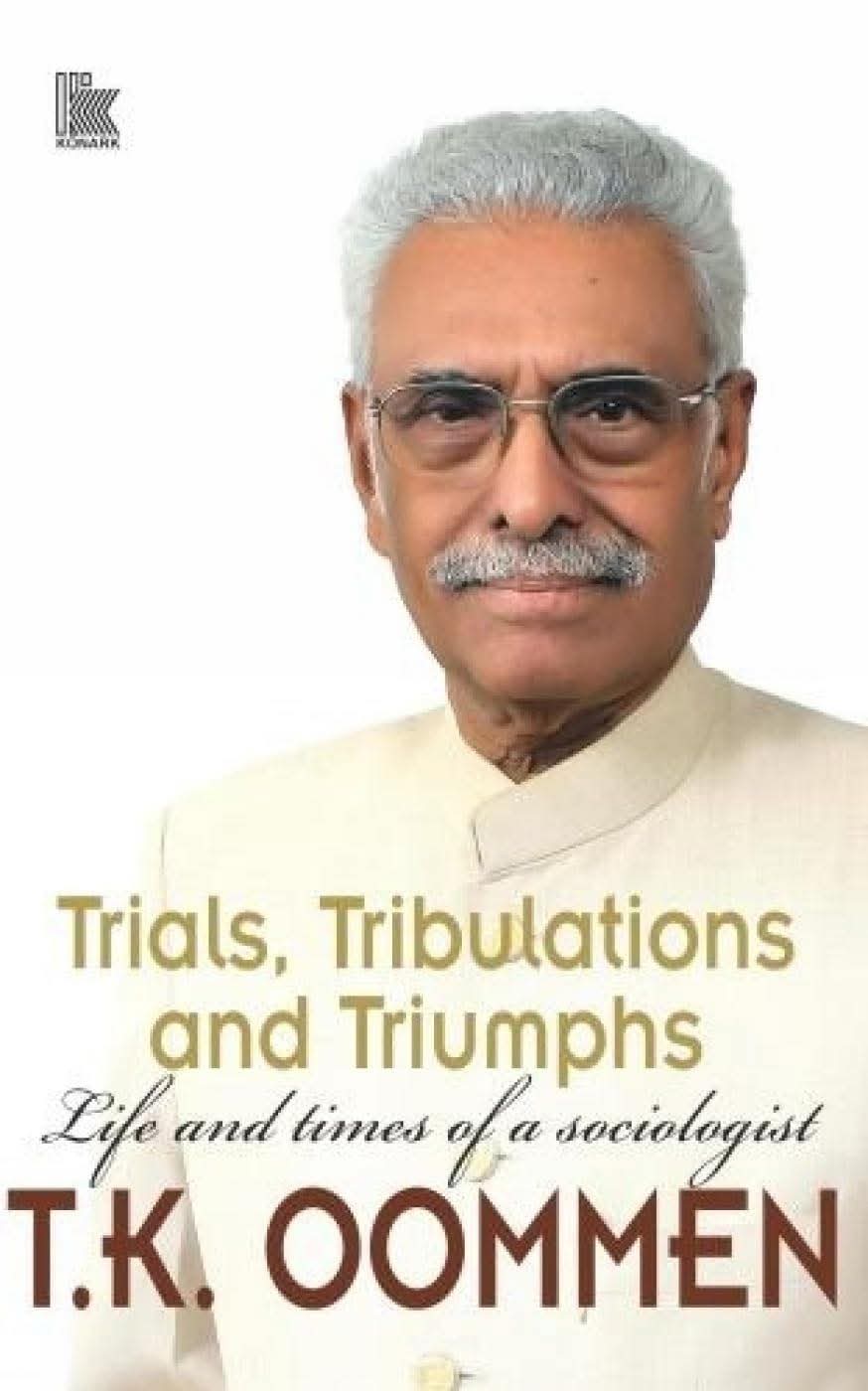
Prof. T.K. Oommen, one of India’s foremost sociologists and public intellectuals, passed away early this morning, leaving behind a formidable legacy of scholarship, public engagement, and institutional leadership. In an academic career that spanned over half a century, he did not merely interpret society — he sought to accentuate its truths, inequities, and possibilities.
Everybody has a fetish for certain words. Regular readers of my writings can identify those that recur with predictable frequency. Prof. Oommen, too, had a favourite: accentuate. The dictionary defines it as making something more noticeable or prominent. In many ways, that single word encapsulated his intellectual mission — to accentuate the realities others preferred to blur.
An anecdote from his days at Jawaharlal Nehru University (JNU) captures both his wit and pedagogical rigour. A Master’s student in Social Theory, convinced that using the professor’s favourite word would curry favour, liberally sprinkled ‘accentuate’ throughout his answer sheet. When the results were declared, he received only a B+ — respectable, but short of the A- he had expected.
Summoning courage, he approached Prof. Oommen to request a review. After listening patiently, the professor asked with characteristic dryness: “Did you expect a better grade because you used the word ‘accentuate’ three times in your answer sheet?”
It was a gentle but profound lesson. Teachers of that generation were sparing with grades, but generous with wisdom. Professor Oommen didn’t just dismiss the student; he consoled him, reminding him that his performance was still solid and that genuine, sustained effort would always trump tactical wordplay. Today, that chastened student is a professor himself, and his most enduring memory is of a teacher who arrived in class meticulously prepared, a stark contrast to those who merely “blah-blah” through lectures.
Meticulousness defined Prof. Oommen’s scholarship. It was evident in his role as a key member of the Sachar Committee, chaired by Justice Rajender Sachar, brother-in-law of Journalist Kuldip Nayar. He represented me in a case the Punjab and Haryana High Court had instituted agsinst me while I was officiating as editor of The Tribune. Constituted amid rhetoric alleging the “appeasement” of Muslims, the committee’s findings revealed a stark reality: the socio-economic condition of Muslims in India was only marginally better than that of Scheduled Castes.
The evidence marshalled in the report forced a shift in political discourse. If anything, the narrative moved from appeasement to claims that Muslims were receiving more than their due — a claim the data did not support. At the time, some observers described the report as the Magna Carta of Indian Muslims. Though it bore Justice Sachar’s name, insiders knew that the drafting bore Prof. Oommen’s intellectual imprint.
His contribution was recognised when the then Vice-President Hamid Ansari insisted on conferring upon him a Padma honour — a testament to the national value of his scholarship.
Prof. Oommen’s intellectual curiosity was not confined to sociology alone. He knew Christianity as intimately as he understood Islam. When Serampore University of William Carey fame sought an expert review of theological education in India, it entrusted the task to him and Prof. Hunter P. Mabry. He designed an elaborate questionnaire that generated 42,000 responses — a staggering primary dataset — which became the backbone of a two-volume report on the state of theological education (The Christian Clergy in India: Social Structure and Social Roles (Sage).
I recall his call asking whether I would review the book for Biblio, a journal devoted to book reviews. Soon, I received the volume along with a request for a 1,500-word critique. I was struck by the meticulousness of his work — an academic survey rendered with clarity and purpose.
Many readers knew Prof. Oommen as a regular contributor to the editorial pages of The Times of India. His articles, often addressing threats to secularism, combined academic rigour with reader-friendly prose. He had the rare ability to translate sociological complexity into accessible public discourse.
When I once invited him to write for the Indian Express, he declined, worried it might antagonise his long association with The Times of India. It was a decision rooted in professional loyalty — a value increasingly rare.
I knew him not only as a public intellectual but also as the younger brother of my colleague at Deepalaya, the late T.K. Mathew. He once remarked, perhaps half in jest, that the siblings were so in awe of their elder brother that they treated him like a father.
My own interactions with Prof. Oommen remain among my most cherished memories. Once, my friend and author of The Deras, Santosh K. Singh, alerted me that Prof. Oommen was visiting Punjab University at Chandigarh. I seized the opportunity. I took him to the Golf Range for a meal and later brought him home for a cup of tea. It was a simple gesture of hospitality, but for me, it became a memorable day — an unhurried conversation with a scholar whose writings I had long admired.
Such moments revealed the man behind the intellectual — warm, approachable, and generous with his time.
Prof. Oommen played a major role in making his sociology department internationally respected. His global connections were so extensive that he was elected president of the International Sociological Association — a rare honour for an Indian scholar.
His friendship with journalists also shaped his life. His association with media figures such as K. Gopalakrishnan of the Mathrubhumi helped him become part of a cooperative colony of media professionals in Gurugram, where he later served as president.
On one occasion, while visiting a sociology professor in Delhi with a friend from Romania, I mentioned that I knew Prof. Oommen. The professor promptly gifted me a manuscript of his autobiography that Prof. Oommen had entrusted to him for editing. It became the second such manuscript in my possession — the first being Alexander MarThoma’s PhD thesis.
Prof. Oommen was also a compelling orator. At a Mar Thoma Church service for students in Dwarka, he startled the congregation by advising students to be like dogs. Eyebrows shot up — until he explained: dogs do not sleep excessively; even in sleep, they remain alert. Students, he said, should cultivate similar vigilance — rest, but do not lapse into complacency.
His intellectual contributions extended to defining communalism as the political manipulation of religious identity — faith transformed into antagonistic political, economic, or social agendas. He identified six dimensions of communalism: assimilationist, welfarist, retreatist, retaliatory, separatist, and secessionist — a framework that remains vital for understanding inter-community conflict.
Dr. George Mathew, founder of the Institute of Social Sciences in New Delhi and the first to earn a PhD under his guidance, often recalled his thesis, The Communal Way to Secularism in Kerala, as evidence of Prof. Oommen’s nuanced understanding of India’s pluralism.
It is a poignant coincidence that Andre Beteille, another towering sociologist, passed away earlier this month. With Prof. Oommen’s death, India loses yet another intellectual giant — a scholar who combined academic excellence with moral courage. He is survived by his wife, who was the Principal of St. John’s School at Greater Kailash, two sons, and their families. Their loss is immeasurable, but so too is the legacy he leaves behind — in classrooms, committees, churches, editorial pages, and the minds he shaped.
Prof. Oommen spent a lifetime accentuating truths — about inequality, secularism, identity, and citizenship. In doing so, he helped India see itself more clearly. As the Bible reminds us: “The righteous will be remembered forever.” (Psalm 112:6)
Discover more from समता मार्ग
Subscribe to get the latest posts sent to your email.