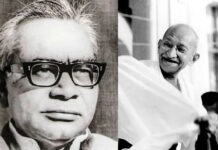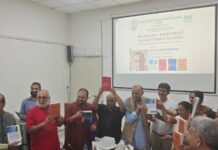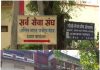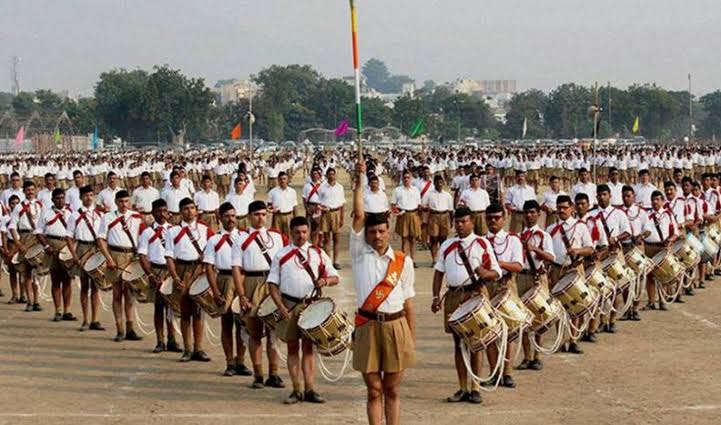
Today, on 4 June 1941, the Rashtra Seva Dal was founded. Today, the Rashtra Seva Dal is completing 85 years. The need for the Rashtra Seva Dal today is far greater than it was in 1941. To strengthen the Rashtra Seva Dal, all of us comrades must take a pledge and move forward.
One of the founders of the Rashtra Seva Dal, S.M. Joshi, was told by Kaki Gadgil (wife of Kakasaheb Gadgil, a leader of Pune’s freedom struggle) in 1941: “Shridhar, our son Viththal has started going to the shakha (branch) of the Rashtriya Swayamsevak Sangh (RSS) these days. They are giving wrong information to such young children against Mahatma Gandhi and against Muslims, and are training them to be misled — even against the freedom movement. Why don’t you people start another organisation that follows Mahatma Gandhi’s ideals, unites Hindus and Muslims and all people living in this country, and prepares children to free our nation?”
It was in response to this question that, on 4 June 1941, in a meeting in Pune, in the presence of S.M. Joshi and other comrades, including Bhausaheb Ranade, Shirubhau Limaye, Annasaheb Sahasrabuddhe, and Raosaheb Patwardhan, the Rashtra Seva Dal was founded.
Incidentally, in 1936, to manage the arrangements for the Faizpur Congress session, a temporary volunteer corps was formed under the leadership of Raosaheb Patwardhan. My father was also part of it. That volunteer organisation was first named Rashtra Seva Dal. The name was suggested by Raosaheb Patwardhan himself at the Pune meeting on 4 June 1941.
At that time, S.M. Joshi was an office-bearer of the Congress Socialist Party. He had just been released from Nashik Road Jail after serving a one-year sentence. He was given the responsibility of being the first Chief of the Rashtra Seva Dal. Before that, he resigned from his post in the Congress Socialist Party and took up the responsibility of leading the Rashtra Seva Dal.
Within a year, the Congress Working Committee at Gowalia Tank in Mumbai unanimously declared the Quit India Movement against British rule. Between 1941 and 1942, more than 125 branches of the Rashtra Seva Dal were established in Mumbai alone, running in three shifts like the textile mills of Mumbai.
This information was shared with me by freedom fighter and socialist leader Navnitbhai Shah from Palghar and his contemporary, Dr. G.G. Parikh, during meetings while I was president of the RSD in 2017. We were on a statewide tour of Maharashtra on the occasion of the 75th anniversary of the Quit India Movement.
Today, does our organisation even have 125 branches across the entire country? The Rashtra Seva Dal was established 85 years ago to provide an inclusive alternative to the Rashtriya Swayamsevak Sangh. Today, where is the RSS and where is the Rashtra Seva Dal?
The RSS has around one lakh shakhas, more full-time pracharaks, and perhaps more swayamsevaks than any other organisation in the world. It has started its units in every sphere of life — from the Akhil Bharatiya Vidyarthi Parishad to the Akhil Bharatiya Adhivakta Sangh — and is active at the all-India level in all fields of life.
The Rashtra Seva Dal was founded 15 years after the RSS, specifically to provide a truly inclusive alternative to it. But looking back after 85 years, it seems that after the programme in Dhule marking the completion of 25 years of the Rashtra Seva Dal in 1966, in the next 60 years — ever since the practice of electing office-bearers through elections began — factionalism started. That is, the biggest flaw of the Indian parliamentary system entered the organisation. As a result, some expert political players have taken control of it.
What has not even occurred to Narendra Modi’s mind yet — capturing an organisation through online elections — perhaps does not even happen in small housing society elections. While conducting online elections, the current misuse of democracy, socialism, secularism, and scientific temper within the 85-year-old Rashtra Seva Dal, and the degradation of its five-point programme (Panchsutri), is a bigger example of decline, paralleling the decline of India’s parliamentary democracy.
Even as one of those who criticise the Election Commission, my tongue falters and my head bows in shame because I have been a soldier of this organisation for 60 years.
The RSS was founded in Nagpur on Vijayadashami day in 1925. On Vijayadashami in 2026, the RSS will complete 101 years, while the Rashtra Seva Dal is celebrating its 85th foundation day.
My public life began in 1966, first in an RSS shakha. There, apart from boys of Savarna (upper) castes, there were no girls or boys from other castes and religions. The maximum effort was to spread hatred against the Muslim community — exaggerating stories from Partition to the present day against the entire Muslim community. Through games, songs, and intellectual sessions, I — being the son of a father who participated in the freedom struggle — repeatedly felt that these people did not utter even a single word about the nearly 200-year British rule (from the Battle of Plassey in 1756 to 1947) and the great freedom movement against it.
Seeing only propaganda about the atrocities of Muslim rulers in their songs, games, and intellectual sessions, I could not remain silent. When I asked senior RSS office-bearers questions, they would simply fall silent. However, their personal behaviour towards me was very good. If I missed even one day of shakha, they would come home and inquire why I had not come.
But in my mind, the question kept arising: Why do they talk so much about Muslim rulers from 200 years before the British? The RSS never said anything positive about India’s freedom struggle — far from it. On the contrary, they blamed Partition for the country’s division and even spoke against independence. I was quite disappointed.
Then someone told me that there was another shakha of the Rashtra Seva Dal running on the premises of a Harijan hostel in a slum area, where both boys and girls participated. So I went there on my own. The shakha conductor, Shri Prabhakar Patil, asked me, “You go to the RSS shakha; what brings you here today?”
I told him that they do not allow Muslims or girls, and they spread a lot of poison against Mahatma Gandhi, Jawaharlal Nehru, and Muslims, which I did not like at all. I had been trying for many days to bring my Muslim friends to the shakha, but they were refused entry.
Prabhakar Patil said, “Look, in this shakha we bring together boys and girls from all castes and religions. So bring your Muslim friends along too.”
This incident is from when I was 13–14 years old — a year after the 1965 India-Pakistan war. Prabhakar Patil had joined the Indian Army and was injured in the war when a bullet passed through his foot while fighting the Pakistani army. He was medically declared unfit and later came to Shindkheda as a full-time pracharak of the Rashtra Seva Dal.
I myself saw the hole left by the bullet that had passed through his right heel — it looked like a pit even after the operation. But while listening to his thrilling firsthand experiences of the 1965 India-Pakistan war, I never once heard him make any hateful comment against the Hindu or Muslim community. This was a very important difference for me.
I also asked him: “You were posted on the India-Pakistan border. How did the Pakistani soldiers behave with you?” He replied, “Until this war, we used to share joys and sorrows about each other’s families. We never felt we were enemies. Suddenly the war started, our officers ordered us to fight each other, and we obeyed.”
Despite being injured by the Pakistani army, Prabhakar Patil — unlike any RSS pracharak — never uttered a single word about Partition or against Muslims. This meant a lot to me. Because I could see the contrast: the RSS did not participate in the freedom struggle; instead, it helped recruit for the British police and army. On the other hand, a Rashtra Seva Dal pracharak who fought in the India-Pakistan war after independence did not speak any communal words.
Yet, despite this, the RSS has created a bogey of Muslims and reached its current position. On the 85th foundation day of the Rashtra Seva Dal, there is a need for introspection and serious thinking.
After 80 years of independence, Indian Muslims have never felt as insecure as they do today — from interference in their food, clothing, and religious programmes to discriminatory treatment in jobs, business, and daily life. In West Bengal, it has not even been a month since the BJP government started bulldozing Muslim homes. During the recently concluded Eid, changes were made regarding animal sacrifice and Eid prayers. It seems that Barrister Muhammad Ali Jinnah’s warning that Muslims would be persecuted in Hindu-majority India has come true — the very reason he demanded Pakistan.
But the Muslims who stayed in India were against the demand for Pakistan. In 1946–47, they rejected the option of going to Pakistan and chose to remain in India. Even then, how many more Pakistans do we want to create by continuously harassing them?
This is a matter of serious thought and concern for the Rashtra Seva Dal. Because over 85 years, the Rashtra Seva Dal has contributed to nurturing thousands of secular Muslims, including Hamid Dalwai, the founder of the Satyashodhak Samaj, and many Muslim brothers and sisters through its shakhas.
That is why I wrote at the beginning that, in the sequence of history, the need for the Rashtra Seva Dal today is greater than ever before. I humbly appeal to all my comrades to set aside personal ambitions, unite, and take a pledge to strengthen the Rashtra Seva Dal so that, in the next 15 years, before its centenary in 2041, we can take its work forward.
Discover more from समता मार्ग
Subscribe to get the latest posts sent to your email.