
— Manisha Kumar —
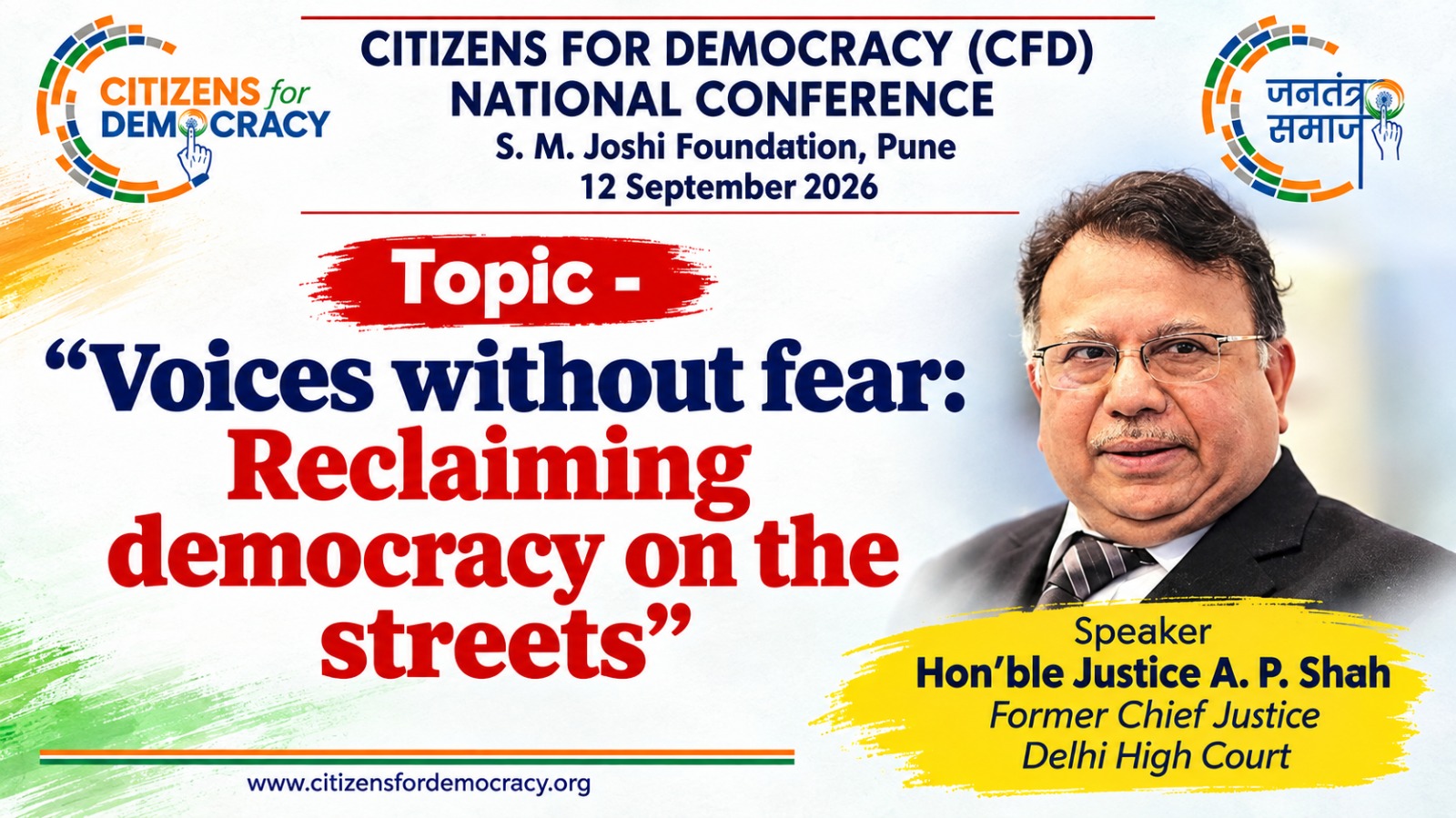
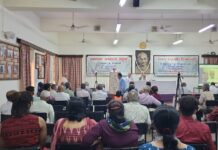
Jutice A P Shah began by addressing the audience as “friends and fellow defenders of the Republic” and described the occasion as an important opportunity to discuss issues at the heart of the nation and its democratic identity. His speech focused on the present challenges facing Indian democracy, the historical role of Citizens for Democracy (CFD), and the importance of citizens particularly young people in defending constitutional values through peaceful public action.
Justice shah argued that principles such as secularism, minority rights, freedom of speech and the right to peaceful assembly are facing considerable strain. At the same time, he identified the continuing tradition of democratic resistance and civic engagement as a source of hope.
1. Historical Origins of Citizens for Democracy
Justice shah placed the origins of CFD in April 1974, when it was founded under the leadership of Lok Nayak Jayaprakash Narayan. The first conference was held at the Gandhi Peace Foundation.
Alongside Jayaprakash Narayan, the founding initiative brought together prominent public figures, including: Justice V. M. Tarkunde,Justice M. C. Chagla,Journalist Kuldip Nayar these figures came together at a time when India was experiencing a serious political, economic and moral crisis.
Justice shah emphasized that understanding the circumstances of 1974 is important for understanding the continuing relevance of CFD.
2. The Political and Institutional Crisis of the 1970s
The speech identified several developments during the 1970s that were considered threats to democratic institutions:
• Growing authoritarian tendencies under Prime Minister Indira Gandhi.Increasing centralization of political power.Economic hardship and inflation.Weakening of the independence of public institutions.Increasing pressure on institutions such as the judiciary.Treating political dissent as a threat rather than as a legitimate democratic activity.He connected these developments to the broader weakening of constitutional protections and fundamental rights.
He argued that electoral politics alone could not adequately protect democratic rights. Citizens therefore had to assume an active role in defending constitutional values.
3. The Role of Civil Society
A central argument of the speech was that political parties and civil society have different roles.
He referred to the founding perspective of Justice Tarkunde that political parties, because they are primarily concerned with electoral politics and political survival, cannot by themselves serve as instruments of moral regeneration.
CFD was therefore presented as an example of an independent civil-society platform whose purpose was not to capture political power but to defend democratic and constitutional values.
This distinction between seeking political power and defending democratic principles forms an important foundation of the speech.
4. Historical Parallels with the Present
Justice shah argued that several concerns visible during the 1970s have contemporary parallels.
He referred to the controversy surrounding the supersession of judges following the Kesavananda Bharati judgment, using it as an example of the political executive’s relationship with judicial independence.
He then drew a comparison with contemporary concerns about the independence and credibility of constitutional institutions, including the judiciary and Election Commission.
The speaker also referred to the Maintenance of Internal Security Act (MISA), which was used during the 1970s against political opponents, and compared it with contemporary concerns regarding the use of the Unlawful Activities (Prevention) Act (UAPA) against activists, scholars and students.
He argued that dissenters today can be portrayed as threats to the state and that students, journalists, academics and retired public servants who raise questions about unemployment, governance, the economy or constitutional rights may face stigmatization.
5. Religion, Majoritarianism and Social Harmony
Justice shah identified another dimension of the contemporary democratic challenge: the political use of religion.
He argued that religion can be used as a political instrument in ways that may affect social harmony;target minority communities;reinforce majoritarian politics; anddivert public attention from economic and governance-related problems.The speaker connected this concern with the larger question of protecting constitutional democracy and equal citizenship.
6. Gandhi and the Capacity of Citizens to Resist
Justice shah invoked Mahatma Gandhi and emphasized the importance of citizens possessing the capacity to resist the misuse of power.
The argument was that Swaraj cannot simply mean the transfer of political power from one group to another. Genuine self-rule also requires citizens to remain capable of questioning and resisting the abuse of authority.
He therefore presented peaceful public protest as an important democratic and constitutional safeguard, particularly when formal institutions fail to adequately protect civil liberties.
7. Democracy Beyond the Ballot Box
One of the major themes of the speech was that democracy cannot be reduced to elections.
He criticized the idea that democratic participation consists only of:
voting once every five years and then waiting for the next election.
According to the speech, democracy requires continuous public vigilance.
Justice shah warned that democratic institutions can sometimes be used through their own legal and institutional mechanisms to weaken democracy. Democratic decline, therefore, may not always occur through a sudden or dramatic event. Instead, it can occur gradually through what the speaker described as a “death by a thousand cuts.”
8. Four Warning Signs of Democratic Decline
Drawing upon the work of political scientists Steven Levitsky and Daniel Ziblatt, particularly their discussion in How Democracies Die, he identified four warning signs of democratic deterioration:
1. Weak commitment to democratic rules
2. Democratic actors may reject or undermine the accepted rules of democratic competition.Treating political opponents as existential enemies
3. Legitimate political opposition may be portrayed as an existential threat rather than accepted as a normal part of democracy.Tolerance or encouragement of political violence
4. Violence may be tolerated, encouraged, condoned or insufficiently condemned.Curtailment of civil liberties
Restrictions on civil liberties may be imposed with impunity, accompanied by suppression of critical voices and opposition. He further suggested that these indicators provide a framework for examining the health of democratic institutions.
9. The Street as a Constitutional Space
The speech then developed one of its central ideas: the street as a constitutional space.
According to the speaker, when formal democratic institutions—including courts, the press or state agencies—become ineffective or fail to adequately protect constitutional values, citizens’ peaceful presence in public spaces becomes particularly important.
Justice shah described dissent as the “oxygen” of democracy and argued that taking to the streets peacefully represents active citizenship rather than passive obedience.
The broader argument is that constitutional democracy does not exist only inside Parliament, courts or government offices. It also exists through citizens exercising their rights to assemble, speak, protest and demand accountability.
10. Young People and Democratic Movements
Justice shah placed particular emphasis on the role of young people in democratic movements.
He referred to the Gujarat student movement of 1973–74, which began around issues such as hostel and food-price increases and subsequently developed into a wider anti-corruption movement.
The movement eventually contributed to the resignation of the Gujarat Chief Minister and became one of the important contexts preceding Jayaprakash Narayan’s Total Revolution movement.
The speaker presented this history as evidence that a movement initially focused on a specific student grievance can develop into a broader democratic movement.
11. International Examples of Youth Movements
To demonstrate that young people have played an important role in democratic and social transformation around the world, the speaker referred to several international examples.
United States: Birmingham Children’s Crusade, 1963
The speaker referred to the Children’s Crusade of 1963 in Birmingham, Alabama, where thousands of young people participated in demonstrations against racial segregation.
The protesters faced severe police repression, including high-pressure water hoses, police dogs and physical violence.
The speaker presented the movement as an important part of the wider civil-rights struggle that contributed to legislative change in the United States.
South Africa: Soweto Uprising, 1976
The speaker next referred to the Soweto Uprising, in which school students protested against the compulsory use of Afrikaans as a medium of instruction.
The movement was met with severe police violence and became a landmark in the struggle against apartheid.
The speaker emphasized that youth resistance could become a powerful force for challenging an unjust political order.
12. Youth Protest in the Digital Age
The speaker then moved from historical examples to the contemporary nature of youth mobilization.
Today’s young people are described as highly educated and globally connected, but they continue to face problems such as:
• unemployment and economic exclusion;unfulfilled employment expectations;restrictions on freedom;concerns about governance; andshrinking democratic spaces.The speaker argued that contemporary youth movements operate simultaneously in digital spaces and physical public spaces.
Social media platforms can be used to circulate information, document events and build solidarity, while physical gatherings give public movements visibility and collective presence.
The reference to protests at Jantar Mantar illustrated this relationship between online mobilization and physical democratic assembly.
13. Recent International Youth Movements
The speaker referred to several recent youth movements around the world.
Bangladesh
The speech discussed the 2024 student-led protests in Bangladesh, which initially focused on civil-service recruitment and quota-related issues but subsequently developed into a wider movement concerning governance.
The speaker presented this as an example of how a specific policy grievance can expand into a broader political movement.
Nepal
The speaker referred to youth protests in Nepal concerning corruption and restrictions affecting digital platforms. According to the speech, young people used digital symbols and decentralized forms of mobilization while demanding political change.
The speaker further connected the movement with subsequent political developments and increased youth participation in elections.
Madagascar
The speaker also referred to ongoing student-led protests in Madagascar, which began around basic public-service failures such as shortages of water and electricity and expanded into broader concerns about corruption, governance and economic stagnation.
The speaker noted that the political situation remained fluid, with significant casualties and changes in political leadership.
Conclusion of the First Part
The first part of the speech establishes a clear conceptual framework around democracy, constitutionalism, civil society, dissent and youth participation.
Its central historical argument is that the creation of Citizens for Democracy in 1974 emerged from a period when citizens felt that formal political institutions alone were insufficient to protect democratic values. The speaker argues that this historical experience remains relevant because democratic institutions require continuous public vigilance.
The speech therefore moves beyond the conventional understanding of democracy as periodic voting. It presents democracy as a continuous relationship between citizens and institutions, in which freedom of speech, peaceful assembly, dissent, civil liberties and public accountability are essential.
The role of young people is given particular importance. From Gujarat and the JP movement in India to Birmingham, Soweto and recent youth movements in Bangladesh, Nepal and Madagascar, the speaker uses historical and contemporary examples to argue that peaceful civic participation can transform specific grievances into wider democratic movements.
The first part ultimately prepares the ground for the speech’s broader theme: “Voices Without Fear: Reclaiming Democracy on the Streets.”
Report on the Second Part of the Speech
“Voices Without Fear: Reclaiming Democracy on the Streets”
1. Youth Movements as a Global Democratic Phenomenon
Continuing from his discussion of international youth movements, the speaker argued that student and youth protests are not confined to India. He referred to recent developments in Madagascar, Indonesia and the Philippines as examples of young citizens mobilizing against corruption, misuse of public resources and failures of governance.
In Madagascar, the speaker noted the continuing political uncertainty following protests and the subsequent punishment of a former Senate President in connection with the security crackdown. He also expressed concern about whether the new military leadership would provide a genuinely democratic alternative.
In Indonesia, student groups reportedly mobilized in cities including Jakarta and Yogyakarta against excessive official privileges and corruption. In the Philippines, youth assemblies reportedly occupied public spaces while demanding greater transparency and independent auditing of public infrastructure expenditure.
The speaker used these examples to argue that the youth mobilization witnessed at Jantar Mantar in Delhi should be understood as part of a wider global phenomenon rather than as an isolated Indian event.
2. The 2026 CJP Youth Protest in India
The speech then returned to India and focused extensively on the 2026 CJP protest.
According to the speaker, the immediate trigger was the controversy surrounding the NEET medical entrance examination and allegations concerning examination paper leaks. The issue generated widespread anxiety among students and families.
Large numbers of young people participated in peaceful demonstrations at Jantar Mantar, New Delhi. The speaker described the protesters as demanding accountability and highlighted incidents in which police used force, including lathi charges and tear gas.
He particularly emphasized the courage displayed by young protesters who remained at the protest site despite police action.
3. Spontaneous Youth Solidarity and Digital Mobilization
One of the most significant features identified by the speaker was the rapid and spontaneous solidarity among young people.
He referred to remarks attributed in the speech to the Chief Justice of India concerning unemployed youth and social-media activists, including the use of the words “parasites” and “cockroaches.” According to the speech, a group of students responded through satire by creating the “Cockroach Janata Party” (CJP) as a play on the name of the Bharatiya Janata Party.
The movement reportedly used the slogan:
“Voice of the Lazy and Unemployed.”
The speaker emphasized the speed with which the movement gained attention through social media. He cited a very large number of followers for the movement’s Instagram account and used this as an example of the ability of young people to mobilize independently through digital platforms.
The broader point was that established political and social institutions may underestimate the frustration and organizational capacity of young people.
4. A Decentralized Form of Political Participation
The speaker identified the organizational structure of CJP as particularly significant.
Unlike conventional political parties, the movement was described as having:
• no conventional top-down hierarchy;no centralized party structure;no formal gatekeeping of membership;no restrictive membership conditions; andan extremely low threshold for participation.According to the speaker, anyone could participate.
This structure enabled participants to see themselves not simply as followers but as co-creators of the movement.
The speaker presented this decentralized organization as an important feature of contemporary youth mobilization, particularly in an era when digital technologies allow individuals to participate directly in political communication and collective action.
5. Satire, Social Media and Alternative Political Communication
The speech emphasized the creative use of satire and digital communication.
Young protesters used:
• satirical slogans;viral videos and reels;digital campaigns;political parody; andsocial-media documentation.The speaker gave examples of slogans that transformed official political messages into critical commentary, including the adaptation of “Make in India” into “Leak in India.”
According to the speaker, these forms of political satire helped challenge established political narratives and draw attention to perceived failures of governance.
The movement also created an alternative digital space where participants could document events on the ground, including police actions and the experiences of protesters.
6. Information, RTI and Democratic Accountability
The speaker then connected digital activism with the importance of accurate information and the Right to Information (RTI).
He argued that access to reliable information is essential for citizens to make meaningful democratic choices.
The movement’s use of social media was presented as particularly significant because protesters could communicate directly with the public without relying entirely on traditional media organizations.
The speaker expressed criticism of sections of mainstream media, arguing that some television channels presented accounts of the protests that differed substantially from the evidence circulated through social media.
This, he suggested, produced two competing narratives about the same event.
The larger democratic significance, according to the speaker, was that digital platforms allowed citizens to access direct evidence, document events and form their own understanding of what had occurred.
7. The Deeper Causes of Youth Protest
The speaker emphasized that the examination controversy should not be viewed as the sole cause of the youth movement.
The examination issue was described as a trigger for deeper anxieties concerning survival, employment and the future.
At the centre of the protest, according to the speech, was a growing sense among young people that the promise of meritocracy was being undermined.
Repeated examination controversies and allegations of paper leaks were presented as damaging public confidence in the fairness of competitive examinations.
The speaker argued that when young people invest years of effort preparing for competitive examinations, they expect a fair opportunity. When examination systems are perceived to be compromised, the consequences extend beyond an individual examination to questions about the credibility of the wider social system.
8. Education, Employment and the Youth Crisis
The speech connected the examination crisis directly with India’s employment crisis.
The speaker acknowledged India’s economic growth but argued that economic growth has not necessarily translated into sufficient numbers of decent and secure jobs for young people.
Several statistics were cited in the speech concerning:
• the number of graduates produced annually;the proportion obtaining employment;the limited availability of permanent salaried positions;graduate unemployment;the concentration of unemployment among educated young people; andthe large number of young people outside education, employment or training.The speaker also raised concerns about the impact of artificial intelligence and technological change on white-collar employment, arguing that changing technology may further intensify uncertainty about the future of graduate employment.
9. Educated Unemployment and Precarious Work
The speaker highlighted a particularly important contradiction: young people increasingly obtain higher educational qualifications while simultaneously experiencing greater employment insecurity.
He referred to graduates and postgraduates applying even for lower-level government positions because of the scarcity of secure employment.
The speaker also discussed the expansion of gig and contractual employment, including work undertaken by delivery workers and drivers.
He argued that many gig workers face:
• limited job security;inadequate social protection;lack of health benefits;uncertain income; andlimited prospects for career advancement.As a result, some educated young people may experience a lower standard of living than their parents had enjoyed.
10. The Crisis Begins at the Primary-Education Level
The speech then broadened the discussion from university education to the entire education system.
The speaker argued that the problems visible at the higher-education and employment levels have roots much earlier in the educational system.
Government primary and rural schools, according to the speech, continue to face challenges such as:
• vacant teaching positions;inadequate basic infrastructure;insufficient drinking-water facilities; andunusable or inadequate sanitation facilities.The speaker connected these concerns with the emergence of another dimension of the youth movement, referred to in the speech as “School Tikoro.”
The argument was that young people increasingly understand that educational inequality begins at the grassroots level and cannot be solved merely through reforms to university examinations.
11. Education and Employment as Common Social Concerns
The speaker emphasized that education and employment are not issues affecting one particular caste, religion or social group.
Unemployment, insecure employment and inadequate education ultimately affect society as a whole.
This, according to the speaker, helps explain the cross-community character of the youth mobilization.
The movement was described as cutting across:
• caste;religion; andcommunal identities.The speaker referred to instances where protesters reportedly shared food on the streets and provided shelter to one another in places of worship.
These acts were presented as evidence of a temporary but significant rejection of divisive politics in favour of shared democratic concerns.
12. Constitutional Values as the Basis of Unity
The speaker argued that the unity visible among protesters was based not on a common religious identity but on shared constitutional ideals.
Four values were highlighted:
• LibertyJusticeEqualityFraternityAccording to the speech, these principles provided a common language through which people from different communities could participate in a democratic movement.
The speaker therefore connected the street protest with the constitutional idea of citizenship: citizens could come together not because they belonged to the same religious or social group, but because they shared commitments to democratic and constitutional values.
13. Marginalization of Minority and Disadvantaged Communities
The speaker then temporarily moved beyond the immediate theme of youth protest to discuss broader concerns about social and political marginalization.
He argued that minority communities and socially disadvantaged groups can experience economic and social exclusion.
He referred particularly to allegations concerning the demolition of homes without adequate due process, commonly described as “bulldozer justice.”
The speaker argued that when a person’s home is demolished merely because that person has been accused of a crime, before the completion of investigation or trial, serious questions arise concerning due process and the separation of institutional functions.
He characterized this as a situation in which the state could effectively become prosecutor, judge and executor simultaneously.
14. Mob Violence and Accountability
The speaker also raised concerns about instances of mob violence and lynching.
He argued that the failure to adequately address such violence can undermine the rule of law and weaken citizens’ confidence in constitutional protections.
The larger point was that democratic constitutionalism requires accountability regardless of the identity of either the victim or the accused.
15. Electoral Participation and the Special Intensive Revision
Toward the end of this section, the speaker introduced concerns about the Special Intensive Revision (SIR) of electoral rolls.
He described the issue as particularly serious because electoral registration is directly connected to citizens’ ability to participate in democratic elections.
He referred to figures concerning voter deletions in West Bengal and mentioned the mechanism through which affected citizens could challenge deletions before tribunals established following judicial intervention.
1. Electoral Rights and the Question of Disenfranchisement
The speaker continued his discussion of electoral rights by raising concerns about the process of electoral-roll revision and the institutional mechanisms created to hear appeals.
He questioned the adequacy of the statutory and institutional framework governing the tribunals and referred to concerns that the appeals process could take several years. He cited the resignation of a former Chief Justice who had reportedly expressed concern about the enormous volume of appeals and the time required to resolve them.
The speaker’s central concern was what happens to citizens whose names are removed from electoral rolls while their appeals remain pending.
He argued that the problem becomes particularly serious for economically and socially marginalized citizens. If a person is unable to establish or retain voting eligibility through a prolonged administrative process, the consequences may extend beyond the right to vote, particularly where access to government entitlements is linked to official documentation.
The speaker acknowledged the distinction between citizenship and the right to vote, referring to the Supreme Court’s position that an electoral-roll determination does not necessarily constitute a determination of citizenship. Nevertheless, he argued that the practical consequences for vulnerable citizens can be substantial.
2. Secularism as a Constitutional Principle
The speech then returned to the question of secularism.
The speaker strongly emphasized that secularism is a non-negotiable constitutional principle. Referring to the Supreme Court’s jurisprudence on the basic structure of the Constitution, he argued that secularism forms an unalterable part of India’s constitutional framework.
According to the speaker, state power should not be used to target minority communities or impose religious uniformity.
He connected this principle with the broader constitutional values of equality, liberty and fraternity, arguing that the protection of minorities is integral to the functioning of constitutional democracy.
3. Higher Education and the Shrinking Space for Critical Inquiry
The speaker expressed particular concern about developments in universities and higher education.
He argued that universities are increasingly experiencing ideological pressures that discourage critical inquiry and encourage conformity.
Among the concerns raised were:
cancellation or disruption of lectures;pressure on academics and speakers;attempts to prevent certain individuals from speaking or performing;ideological considerations in academic appointments; andchanges to university curricula and history textbooks.The speaker suggested that independent academic talent should be protected and that universities must remain spaces where different viewpoints can be examined freely.
4. Academic Freedom and University Appointments
The speech questioned whether ideological considerations are influencing appointments to senior positions in universities.
The speaker argued that academic institutions require intellectual independence and that appointments should be based on academic merit and institutional integrity rather than political or ideological conformity.
For him, the issue was not merely about individual appointments but about the larger character of universities as institutions dedicated to critical inquiry and the pursuit of knowledge.
5. Changes in History Textbooks
The speaker also discussed changes to history curricula and textbooks.
He referred to the removal or reduction of certain historical periods and argued that selective rewriting of history can deprive young citizens of a comprehensive understanding of India’s past.
Using an analogy attributed to writer Naseeruddin Shah, he compared such a reduced version of historical knowledge to a “bonsai”—a smaller and restricted version of something that should otherwise grow fully.
The speaker argued that excluding significant periods or communities from historical narratives risks producing citizens who possess an incomplete understanding of their country’s history.
This was presented as an educational and democratic concern because citizens require access to a broad historical record in order to develop informed perspectives about society and the nation.
6. The State’s Response to Youth Mobilization
The speaker then examined the state’s response to the youth movement.
He argued that the initial response was characterized more by containment than engagement.
According to the speech, peaceful student marches and sit-ins were met with: police deployment;lathi charges;tear gas; andother forms of crowd-control measures.The speaker referred to the use of pellet-type munitions and expressed concern about the possibility of serious injuries.
He argued that the state’s response to peaceful democratic protest should instead prioritize dialogue and engagement.
7. Criminalization of Protesters
Another major concern raised was the filing of criminal cases against student protesters.
The speaker described what he regarded as a particularly troubling situation in which an injured protester could subsequently become an accused person.
He characterized this as a reversal of the relationship between victim and accused:
“Where the victim becomes a criminal.”
The larger argument was that the criminal-justice system should not be used to intimidate citizens exercising legitimate democratic rights to peaceful protest and expression.
The speaker also referred to the use of stringent laws such as the UAPA in cases involving activists, arguing that such laws can have a chilling effect on dissent.
8. The Politics of Labelling Dissent
The speaker strongly criticized the practice of attaching derogatory political labels to critics and protesters.
He referred to a succession of labels allegedly used against dissenters, including terms such as:
• “anti-national”;“urban Naxal”;“foreign-funded”;“toolkit”;and other newly created expressions.He argued that continually inventing new labels serves to delegitimize critics without engaging with the substance of their arguments.
The speaker compared this phenomenon with historical examples of propaganda in which governments or political authorities attempted to portray opponents as enemies of the state.
His argument was that branding dissenters can create an atmosphere in which legitimate criticism becomes socially or politically dangerous.
9. Youth Resistance to Intimidation
Despite these pressures, the speaker argued that young protesters continued to exercise their democratic rights.
According to him, the youth movement demonstrated that intimidation does not necessarily eliminate dissent.
Instead, the protesters: continued to organize;documented events;communicated directly with the public;challenged official narratives; andmaintained their demands for accountability.The speaker regarded this persistence as an important indication of democratic resilience.
10. Political and Executive Accountability
The speaker then discussed what he considered one of the important achievements of the youth movement: executive accountability.
He argued that sustained public pressure and documentation of failures eventually resulted in political responsibility being acknowledged for the examination-paper leak controversy.
The speaker described the reported resignation of the Union Education Minister as a significant example of how sustained civic pressure can influence executive accountability.
For the speaker, the importance of such an outcome extended beyond the immediate controversy. It demonstrated that citizens can still demand answers from those exercising public authority.
11. Breaking the Climate of Fear
A major theme of this section was the idea that the youth movement had challenged a broader climate of fear.
The speaker argued that many independent voices had been discouraged or silenced in recent years. Young protesters, however, demonstrated that citizens can reclaim public space through peaceful participation.
They faced police action and attempts to discredit them, but continued to raise questions and document their experiences.
The speaker regarded this as a significant contribution to democratic culture.
12. A New Language of Democratic Protest
The speaker highlighted the distinctive style of the youth movement.
Unlike traditional political mobilizations, the protests were described as:
• creative;humorous;satirical;digitally sophisticated;direct; andpeaceful.The speaker emphasized that the protesters were not simply repeating traditional political language. They adapted democratic participation to the communication culture of their generation.
Satire and humour became tools for questioning political authority, while social media allowed information to circulate rapidly.
13. Democracy as a Shared Responsibility
The speaker argued that the responsibility for defending democracy cannot be left exclusively to young people.
He emphasized that the youth movement should be understood as a reminder to the whole of society.
Citizens must decide how they respond when constitutional and democratic rights appear to be under pressure. According to the speaker, society has two broad choices: remain silent or ask questions, raise one’s voice and demand accountability.
The metaphor used was that “the ball is now in our court.”
The responsibility therefore extends beyond protesters to academics, professionals, civil-society organizations, political actors, journalists and ordinary citizens.
14. Limits of Traditional Party Politics
The speech also reflected on the limitations of conventional party politics in the digital age.
The speaker argued that contemporary technology makes it possible for ordinary citizens to organize themselves independently, without necessarily relying on traditional political-party structures.
He presented the youth movement as a possible template for non-partisan civil-society organization.
Such platforms could: monitor government performance;document public grievances;organize citizens;demand accountability; andprotect constitutional rights.The speaker suggested that similar forms of digital organization can also be applied to local civic concerns, such as noise pollution and excessive use of loud music.
15. Digital Media and Democratization of Public Participation
The speaker emphasized that social media has significantly reduced the barriers to public participation.
In the past, an individual located in a remote area might have struggled to bring a local problem to national attention. Digital platforms now make it possible for individuals to document an issue and communicate it directly to a much larger audience.
This creates new possibilities for bottom-up democratic communication.
However, the speaker’s emphasis was not simply on social media itself. He stressed the importance of combining digital communication with careful documentation and factual evidence.
16. RTI as a Democratic Instrument
The Right to Information Act (RTI) was identified as another important democratic instrument.
Even while acknowledging limitations in the functioning of the RTI framework, the speaker argued that it remains a valuable tool through which citizens can seek information from public authorities.
Access to information, in this understanding, strengthens citizens’ ability to:
• question government decisions;monitor public institutions;document failures; anddemand accountability.
17. Accountability of All Constitutional Institutions
In the concluding section, the speaker broadened the demand for accountability to all arms of the state, including the judiciary.
He argued that the judiciary has a particularly important responsibility to protect democratic rights and vulnerable citizens.
The issue of electoral disenfranchisement was again highlighted. The speaker stressed that vulnerable citizens should not lose their voting rights merely through an administrative process that has not been adequately tested against constitutional principles.
The protection of voting rights was therefore presented as fundamental to democratic citizenship.
18. The Street as the Space of Constitutional Democracy
The speech concluded by returning to its central theme: the street as a democratic and constitutional space.
For the speaker, public protest is not inherently a challenge to democracy. Peaceful protest can instead be a means through which citizens defend constitutional values and demand institutional accountability.
The final message was that democracy survives when citizens refuse to allow fear to silence them.
The speaker concluded with the idea that:
“The street remains the ultimate space where our constitutional values are defended.”
The speaker’s central claim is that democracy cannot survive through institutions alone. Courts, universities, elections, political parties, media organizations and government agencies all have important roles, but active citizens are essential to ensuring that constitutional values remain meaningful in practice.
The youth movement is presented as an example of this active citizenship. Through peaceful protest, satire, digital communication, documentation and collective action, young citizens demonstrated new forms of democratic participation.
At the same time, the speaker insists that the responsibility cannot remain with the youth alone. The larger society must decide whether it will remain silent or participate in defending constitutional rights.
The speech therefore ends where its central theme began: democracy requires voices without fear, and the public sphere including the streets remains an important space in which citizens can reclaim, express and defend constitutional values.
Discover more from समता मार्ग
Subscribe to get the latest posts sent to your email.










जल्दी से इसकी पुस्तिका सी एफडी के तरफसे प्रकाशित करने की आवश्यकता है 🤔