
— Jogi Panghaal —
In the centre of New Delhi stands an unusual institution. It has no vice-chancellor, admissions office, classrooms or examinations, and awards no degrees. Yet every day it teaches India something about itself. Its name is Jantar Mantar.
Parliament lies a short walk away. Connaught Place is close by. The Metro brings students, workers, researchers, journalists, tourists and ordinary citizens into its neighbourhood. Anyone can arrive, spread a sheet upon the pavement and place before the country a grievance, an idea, a proposal or simply a question. There is no application form. Only the courage to begin.
The name Jantar Mantar belongs first to astronomy. Delhi, like Jaipur, has its own observatory, though smaller: extraordinary instruments built to observe celestial bodies and locate ourselves in relation to them. Over time, its name has also come to identify the ground around it, officially designated for public protest.
And so another instrument has appeared beside the astronomical one. The old instruments ask where celestial bodies stand in relation to one another. The gathering outside asks where farmers stand in relation to policy, students to opportunity, workers to wages, women to safety, minorities to power. One seeks orientation in the heavens. The other within society.
The questions change every day. The instrument remains.
For years I thought of Jantar Mantar simply as a place where protests happened. Then I began to think of it as a university. The word university originally referred not to buildings but to a community gathered in search of understanding. Before it became architecture, it was a way of learning together. Jantar Mantar returns us to that older meaning. There is no curriculum because society becomes the curriculum. Life rewrites the syllabus every morning.
A school student may learn more about democracy here in an afternoon than through months of civics lessons. A farmer may teach an economist what rainfall means when it fails. A domestic worker may explain the city to an architect. Statistics acquire a different weight when spoken by those who live inside them. Knowledge changes hands. Education becomes an encounter between different experiences of life.
Yet even university began to feel insufficient. Universities produce knowledge. Jantar Mantar seemed to produce something else.
When a gathering ends, banners are folded, microphones disappear and people return home. Yet something remains in circulation. A phrase enters everyday language. A song travels to another city. A poster reappears in a university hostel. Friendships outlive the demonstration. Conversations find their way into tea stalls, village squares and family dining tables. The visible event ends. Its invisible work continues.
Slowly Jantar Mantar began to resemble a design studio. The comparison seemed improbable. Design studios contain drawing boards, prototypes, tools and material samples. Jantar Mantar possessed none of these. Then I realised that a studio is defined not by its furniture but by what it makes. Industrial design produces objects. Communication design produces meaning. Service design produces experiences.
What, then, does social design produce?
Sociality.
By sociality I mean that delicate condition in which strangers begin to recognise one another as participants in a shared world: through trust, care, conversation, disagreement, collective imagination. It is the process through which a crowd becomes a public.
Once I saw this, everything acquired another meaning. Slogans became attempts to find a language many voices could inhabit. Songs became rehearsals in belonging. Posters became shared acts of making. Conversations over paper cups of tea quietly wove relationships between people who, hours earlier, had been strangers.
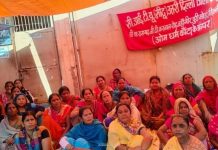
Like every design studio, Jantar Mantar begins with a brief. Only here the brief arrives with the people. Someone unrolls a banner. Someone makes tea. A group debates the wording of a slogan. Students sit cross-legged on the pavement. Journalists drift between conversations. Visitors stop, listen and move on. Others stay. Gradually, another kind of order emerges.
A slogan is spoken aloud. It doesn’t quite work. A word changes, another rhythm is suggested, more voices join. By the time it leaves Jantar Mantar, it no longer belongs to whoever first uttered it. It has become common property. The same happens with songs, poems, stories and laughter. Ideas here are not merely announced. They are composed.
Other acts appear without instruction. Someone sweeps the ground. Another gathers discarded bottles. Drinking water arrives. A place is made for an elderly visitor. Someone guides another towards medical help. Nobody appointed them. They saw what was needed. Care has entered the design process.
And the studio expands. During recent student demonstrations, meals began arriving from across India and from people elsewhere in the world, often with one instruction: “Please give this to anyone who is hungry.” Anonymous people paid for hundreds, sometimes thousands, of meals. Medicines arrived until organisers asked people to stop sending them because there was nowhere to store them.
A woman in Himachal Pradesh saw children struggling in Delhi’s heat and sent hand fans. She could not stand among them, yet found another way of being present. Nearby gurdwaras kept their langar open. The gathering was no longer sustained only by those who were there. An ecology of care had formed around it.
Among the young, another transformation was visible. Many first encountered Jantar Mantar through Instagram. They arrived carrying posters, poems, songs, performances and visual languages shaped online. Once there, these individual expressions entered a larger choreography.
Sometimes it began with someone humming a familiar tune. New words were fitted to it—words belonging to the moment. They were tried, altered and repeated. More voices joined. Someone found a better rhythm. Someone added music. A tune that belonged elsewhere acquired another life.
“Police wale babu, ek danda to laga do” and “Desh ki tabahi ka hisab dijiye” were among the songs composed, tuned, danced to and eventually owned by the crowd. Their authorship became difficult to locate. Creativity was passing from one person to another.
And then the song entered the body.
Children danced. Young people carrying placards began moving together. A shoulder found the beat. Feet found a rhythm. The body, accustomed perhaps to being watched, instructed or contained, discovered its own movement. In dancing, it discovered its centre.
When hundreds of bodies responded to the same beat, nobody was moving alone. Without instruction, the gathering found a centre of its own—not marked upon the ground or occupied by a leader, but made momentarily between bodies.
The individual finds a centre within the body. The gathering finds a common centre between bodies. For a few minutes, the two coincide.
Perhaps this too is how a crowd becomes a public. The song ends. But the body remembers.
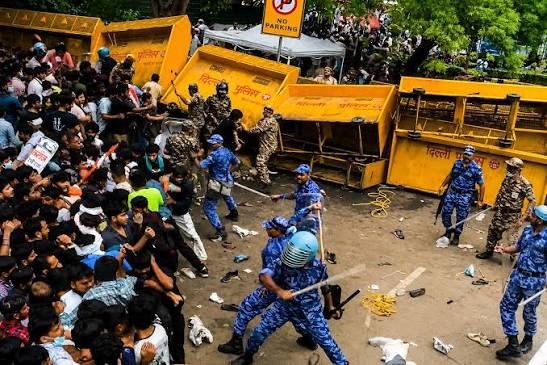
There came a moment when this gathering wanted more than to be heard. Students demanding the resignation of a minister over the leaking and widespread trading of examination papers began an indefinite hunger strike, invoking an old Gandhian instrument of moral pressure. When this failed to move the government, they decided to march towards Parliament.
Police stopped the march violently. Young men and women who had found one another from across the country confronted barricades and force. Students were badly injured. Police personnel too suffered injuries as some within the gathering acted aggressively. Images of the confrontation travelled through social media.
Instead of dispersing the protest, the violence enlarged it. Students gathered again in far greater numbers. What happened to bodies on a Delhi street was watched on screens across the country. Sympathy travelled. Anger travelled. More bodies arrived.
Eventually the minister resigned. The students went home triumphant. But something else had shifted. A demand that began on a small piece of ground had moved towards the centre of national attention.
Here the common centre acquires a political meaning. Sometimes, when enough bodies gather around a question that will not go away, they shift the centre of the body politic itself.
Perhaps only by a little. But politics, like the astronomical instruments beside it, is concerned with position: what lies at the centre, what remains at the edge, and what has begun to move.
We usually judge design by what it produces. The measure of social design is different. Its success lies in enlarging the possibilities of living together. Sociality becomes culture. Culture informs how a society imagines its future.
Songs continue to be sung. Friendships endure. Networks of care remain. Stories are retold. New words enter everyday speech. Futures once difficult to imagine become possible. These are traces left behind after the protest has gone.
We imagine societies are held together by constitutions, governments and institutions. They provide structure. But structure alone does not make a society. Society is also made when strangers recognise one another, share food, invent a phrase, sing together, disagree and remain together, or make room for someone they did not know yesterday.
Sociality has to be made, again and again. Perhaps that is among the oldest works of democracy.
At Jantar Mantar, the old instruments still stand, measuring the movement of bodies across the sky. Outside, other bodies gather. They speak, argue, eat, sing and sometimes dance. In doing so, they begin to recognise not only the question that brought them there, but one another. A concern, a grievance, a hope or a possibility becomes something shared. A crowd begins to become a public.
Somewhere on the way home, someone is still humming the tune, carrying a little Jantar Mantar with them.
Discover more from समता मार्ग
Subscribe to get the latest posts sent to your email.