— MOHAN GURUSWAMY —
The creation of Telangana, almost sixty years after the people of the region voiced their misgivings about being co-opted into Andhra Pradesh is yet another step in rationalizing and restructuring the Union of States that India is meant to be. India was never meant to be a union of linguistic states, but a union of well governed and managed states. The experience of the small states have been uniformly good.
Thus, the demand for newer administrative units will be a continuous one, one that seeks to bring distant provincial governments in remote capitals closer to the people. Even as the rites to formally create Telangana are underway, old and dormant demands are surfacing. Before it formed the government in Maharashtra, the BJP was in favour of a Vidarbha state. Mayawati has several times expressed a view that UP needs to be broken into three or four states. Even in Tamil Nadu Dr.S.Ramadoss of the Pattal Makkali Katchi (PMK), a very regional political party, has mooted a bifurcation of Tamil Nadu, with the northern districts being carved out to form a separate state.
The yearning for linguistic sub-nationalism is a post independence phenomenon. Often this linguistic sub-nationalism has been a fig leaf for secessionism as we have seen in Tamil Nadu and Punjab in the past.
The biggest states of India, Bihar, Madhya Pradesh, Rajasthan and Uttar Pradesh are also its worst off states and hence the acronym BIMARU for them is most appropriate. They are also predominantly Hindi speaking states and hence quite clearly there is no linguistic or historical basis for their creation and existence as they are. Yet within their blanket linguistic conformity these states cover a vast diversity of distinct regions, with characteristic commonly spoken languages, culture and historical traditions.
Each of these states either in terms of landmass or population still would larger than most countries in the world. Even without Uttaranchal, UP would be larger in terms of population than Brazil, Japan or Bangladesh. It was not surprising that despite the supposed linguistic affinity, there were and still are demands for smaller states from within them. All the major political parties supported such aspirations and four new states are the result.
At a time when caste has so fragmented the polity, the demand for small states with a long and traditional affinity often cemented by a common agro-climatic reality becomes a strong motivating force to rally the disenchanted and dispossessed to a common cause. But this must not be allowed to discredit the case for smaller and more manageable states.
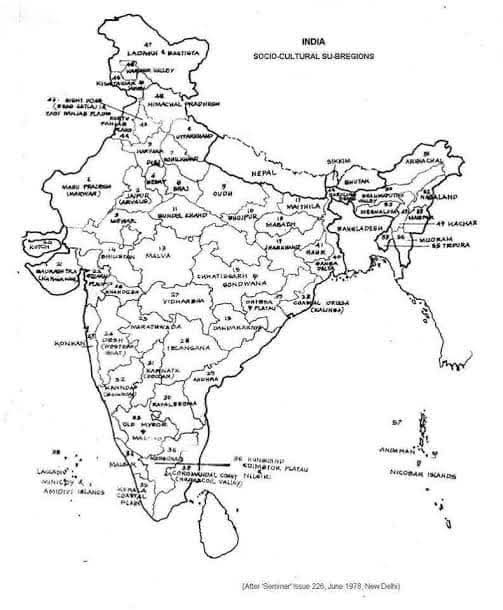
The late Dr. Rasheeduddin Khan most eloquently made out this case; of Hyderabad I would like to add, way back in April 1973 in the Seminar, at that time edited by the late Romesh Thapar. He had India divided according to its 56 socio-cultural sub-regions and a map showing these was the centerpiece of the article. That picture still remains embedded in my mind, and whenever I think of better public administration that map would always appears.
The Seminar map is a veritable blueprint for the administrative restructuring of India. Out of UP and Bihar eight distinct sub-regions are identified. These are Uttaranchal, Rohilkhand, Braj, Oudh, Bhojpur, Mithila, Magadh and Jharkhand. The first and last of these have now become constitutional and administrative realities. But each one of the other unhappily wedded regions is very clearly a distinct region with its own predominant dialect and history. For instance Maithili spoken in the area around Darbhanga in northern Bihar is very different from Bhojpuri spoken in the adjacent Bhojpur area.
Similarly Brajbhasha in western UP is quite different from Avadhi spoken in central UP. India’s largest state in terms of area, MP, is broken into five distinct regions, Rajasthan, Gujarat and Maharashtra into four each, AP, West Bengal and Karnataka into three each, Tamil Nadu, Kerala and Orissa into two each, and so on.
Since 1971, India’s population has doubled to cross 1.3 billion. Even at constant prices (1980-81) the GNP has grown by ten times. In 1971 the total money supply (M3) was Rs.11, 019 crores, whereas it has now grown to over Rs. 16,00,000 crores (sixteen lakh crores). In PPP terms it would be closer to Rs.70 lakh crores. Naturally the size and scope of government has also changed. The 1980-81 budget of the Government of India was a mere Rs. 19,579 crores. It is now over Rs. 1000,000 crores. The annual budgets of state governments too have grown likewise. States like UP, Maharashtra and even Telangana now have annual budgets of over Rs.100, 000 crores each. All the states together have a total annual expenditure in excess of about Rs.900, 000 crores. Last year the total gross fiscal deficit of the states alone was about the same as the Government of India’s.
The total population of India in 1947 was about 320 million. Today, we have about that number of people who are below the poverty line. In the meantime India has become a very youthful country with 70% of its people below the age of 30 of whom about 350 million are below the age of 14. Clearly the task of government is not only much more enormous, but also much more complex when the rising expectations, impact of new technologies and demographic changes are factored in. Our record so far is cause for great concern and is a severe indictment of the failure of the system of governance in India.
That “the nature of the regime determines the nature of the outcome” is a well-known adage in public administration and public policy studies. The nature of a regime is not only influenced by its Constitution, guiding philosophy, and the consequent system of government, but also by the structure of the system. We know from experience, both in the corporate world and in public administration, that monolithic and centralized structures fail when the size and scope of the organization grows. Thus to compete with Honda and Toyota, General Motors and Ford have had to restructure into smaller and independent operating units. In public administration this is called de-centralization.
De-centralization not only implies the downward flow of decision-making but also greater closeness of the reviewing authority to the decision-making level. Thus, if more decision-making flows to the districts and sub-districts, the state government, which is the reviewing authority, must also have fewer units to supervise. I have always held that the real concentration of power is not with the Central Government but with the State Governments. Thus when a person like Mamata or Jayalalithaa or Mulayam Singh Yadav clamors for greater functional autonomy, she/he is actually calling for a greater concentration of power in oneself. From the perspective of good governance, this is clearly unacceptable.
Good government also means lesser government, responsive government, closer government and quicker government. Large centralized governments are inimical to good government. State Governments are the worst kind of centralized governments masking their regional jingoism as a demand for autonomy.
The “Report of the States Reorganization Commission, 1955” stated: “Unlike the United States of America, the Indian Union is not an indestructible union composed of indestructible states. But on the contrary the Union alone is indestructible but the individual states are not.”
It would be unfortunate if demands for the restructuring of India by creating more states are seen only as mere political contests, where the just causes of individual socio-cultural and agro-climatic regions is just a weapon of in the hands of out of work politicians deprived of a share of the benefits of office. Small states are a must if we have to make the Republic healthy and strong.
Discover more from समता मार्ग
Subscribe to get the latest posts sent to your email.