— MOHAN GURUSWAMY —
Before the pandemic locked him away from contemplating policies, the Prime Minister and his economic management team met the captains of India’s private sector, trade bodies and a few others to discuss the economic situation and the challenges and opportunities ahead on India’s roadmap to industrial growth and economic prosperity. However his list of invitees betrayed his myopia. He obviously believes that the private corporations are the ones who will lead India’s economic growth and provide it with the entrepreneurship and vision required to make our dreams come true.
He seems to forget that most of our major companies have business models based on obtaining government assets, be it hydrocarbons or mineral ores or spectrum, at low prices and selling the products and services at market prices. He also misses the fact that most of industrial investment in India is by the State, and unless these become productive and profitable, India’s industrial sector will languish. The private sector by contrast does well and the challenge for the government is to make the public sector do as well. This does not always entail privatization.
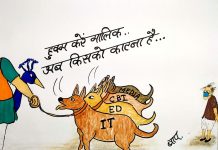
Yet in the past six years he has been in office, Prime Minister Narendra Modi has shown a singular lack of interest in the public sector where our economic and industrial malaise is concentrated. Because of this one would have thought that he would have invited some more PSU bosses to understand their problems and seek ideas and advice from them on how to jump start the moribund PSU’s so that they can contribute to growth in a meaningful way. But alas this was not be. Like all his predecessors, Narendra Modi too is all eyes and ears to people who contribute not just to our economics but even more so to our politics?
Thirty-nine years ago in 1980-81 the capital invested in Central PSU’s was Rs.18, 207 crores and they had a combined turnover of Rs. 28,635 crores. In 2014 the total capital employed in the 383 CPSU’s is a huge Rs.330, 626 crores, with an additional Rs.881, 774 crores as long term loans, almost all of it from government financial institutions and from the central government directly. These companies together have a market capitalization of Rs.1, 106,657 crores. Of these CPSU’s, 202 were profitable registering a cumulative profit of Rs.153, 907 crores, and 124 had losses amounting to Rs.49, 612 crores. They also employ 15.59 lakh workers and managers. This investment generates a turnover of Rs. 14,13,992 crores. The state owned oil sector accounts for a little over Rs.10 lakh crores of this.
The GDP in the year 2013-14 was Rs. 113.45 lakh crores. Therefore the CPSU’s together contributed almost a tenth of the national income. Considering that the entire industrial sector only contributes about 26% of GDP, it is quite obvious that many if not most of the commanding heights of the economy are still with the public sector. India has made huge investments in the public sector and has never got even halfway to a fair return on them.
Clearly the overall picture is not a rosy one, for our PSU’s depend on administered prices and are mostly oligarchies in many major sectors such as coal, hydrocarbons and minerals. The state oil companies contributed Rs.46, 745 or 30.37% of all PSU profits; the coal sector Rs.31, 513 or 20.48%; and the power sector Rs.22, 111 crores or 14.37%. The 41 PSU’s in these three sectors together provided Rs.100, 369 crores or 65.22% of PSU profits. If you keep these three sectors aside, the rest of the PSU’s together earned about Rs.1000 crores. This is a sorry state of affairs. Quite clearly we are unable to extract any benefits from the huge investments made in these companies. The PM should focus his attention of improving their performance instead of being attentive to only the needs of the private sector, which for the most part are well managed and are profitable.
Soon after he assumed office, Narendra Modi indicated plans to do more with state-controlled companies than use them as piggy banks to break into whenever the government needed a revenue boost. He said he had plans to sell off the traditional laggards and to fix the ones with potential. He also signaled the government had plans to privatize state-run firms and unfetter them from the clutches of the middle bureaucracy of deputy and joint secretaries. There is no sign of this any of these happening. PSU holdings are being off loaded to plug revenue gaps without any plan to make PSU’s profitable and contribute to the States coffers.
But solutions are possible that will enable the Public Sector to become a profitable, productive and contributing sector of our economy. The critical first step would be to take all the PSU’s from out of their administrative ministries and bring them under one administrative ministry whose mandate would be to make the PSU’s cumulatively profitable, not as they presently are but in a real sense giving the nation a proper rate of return on its stupendous investment.
Then by a process that selectively uses liquidation, outright sale, restructuring and amalgamations new, viable and profitable entities could be created whose ownership could then be progressively diluted to broad base it and liberate these companies from bureaucratic and ministerial control. All this is possible, but only if the Prime Minister focuses his attention on reforming and restructuring our PSU’s and on realizing returns on the huge investments the nation has made on them.
Discover more from समता मार्ग
Subscribe to get the latest posts sent to your email.