— Atamjit —
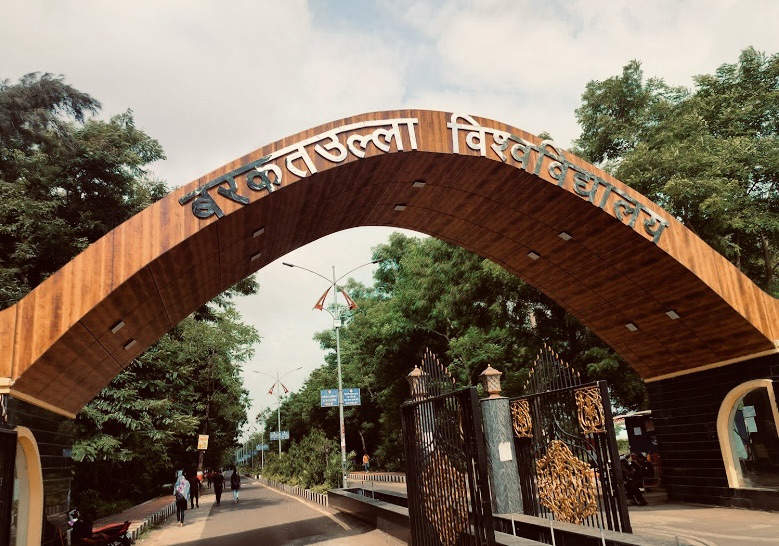
The executive council of the State University in Bhopal recently passed a resolution asking the Madhya Pradesh government to rename the institution to Vagdevi Bhojpal University. “Vagdevi” refers to Goddess Saraswati, and “Bhojpal” is the old name for Bhopal, tied to Raja Bhoj. Saraswati is the goddess of knowledge and wisdom, and Raja Bhoj was a legendary scholar. Back in 1970, it used to just be called Bhopal University.
This new proposal might seem perfectly fine—until you realize that back in 1988, under Congress Chief Minister Arjun Singh, it was renamed Barkatullah University to honor a massive figure in the freedom struggle from the Ghadar Party. So, the real question here is: is this name change actually about celebrating Raja Bhoj, or is it just an excuse to strip a Muslim name off the university?
Who Was Barkatullah Bhopali?
Born in 1854, Barkatullah spent his entire life fighting the British Empire on a global stage. He was a founding member of the Ghadar Party of India (started in Sacramento, California), which aimed to overthrow colonial rule back home. Even though he was a religious Muslim scholar, he was fiercely secular and deeply patriotic. Many German historians have noted that he put nationalism way above religion. They base this on the fact that Barkatullah went to Berlin in 1914 to set up the ‘India Council for Independence.’ Even though Indian soldiers were fighting for the British at the time, Barkatullah urged Muslims to back Germany instead, seeing it as a way to liberate India. In his 1924 book Khilafat, he explicitly wrote that while Muslims could look to a global Caliph for spiritual guidance, their political loyalty belonged entirely to their own country.
When India’s first provisional government-in-exile was formed in Kabul in 1915, Raja Mahendra Pratap Singh became the President, and Barkatullah was the Prime Minister. He brilliantly blended his Islamic worldview with leftist, Marxist ideas without any contradiction, believing both stood up for the oppressed and opposed imperialist expansion.
He was a master of Arabic, Persian, and Urdu, and even taught them in London. His English was flawless. But because he wanted to connect India’s freedom struggle to the rest of the world, he also learned Turkish, German, French, and Japanese (which he later taught in Japan). Though not a Marxist himself, he did everything he could to get global backing for Indian revolutionaries. In May 1919, he and Raja Mahendra Pratap even met Vladimir Lenin in Russia to secure financial and political help. Lenin promised his support, but after Afghanistan signed a treaty with the British, the plan stalled, and they had to leave Afghanistan. Interestingly, a state university was set up in Aligarh in 2021 named after Mahendra Pratap Singh.
A True Nationalist
While Maulvi Barkatullah wanted to rally Muslims worldwide against colonial rule, the entire history of the Ghadar Party points to him being a committed nationalist. When Lala Har Dayal and Baba Sohan Singh Bhakna formed the ‘Hindi Association of the Pacific Coast’ in 1913—which later became the Ghadar Party—Maulvi was right there with them. Thanks to his sharp intellect, he was made the party’s Vice President. He also took on the responsibility of editing and distributing the Hindustan Ghadar newspaper. When Lala Har Dayal was arrested in 1914, Barkatullah and Ram Chandra kept the anti-colonial propaganda running through the paper.
He was deeply connected to the Ghadarites’ headquarters, Yugantar Ashram, in San Francisco, and played a major role in setting it up. It was from here that he tried to take Ghadar ideas global. In May 1914, he and Giani Bhagwan Singh traveled around, giving speeches to convince people to head back to India and overthrow the British government.
A famous Persian letter he wrote in 1907 (published in an Aligarh Urdu paper) is often seen as incredibly prophetic. In it, he laid out four main points:
1. Freedom is impossible without absolute Hindu-Muslim unity.
2. Indian Muslims must remain loyal to India, even while maintaining ties with the global Muslim community.
3. People must resist unjust British laws.
4. Everyone should adopt Swadeshi (local/indigenous goods).
By 1918, the British Rowlatt Commission (officially the ‘Sedition Committee Report 1918’) flagged Barkatullah’s letter as a blueprint for an international conspiracy. The Rowlatt Act itself—formally called the ‘Anarchical and Revolutionary Crimes Act 1919’—was specifically designed to crush the actions of people like Barkatullah. Mahatma Gandhi launched a Satyagraha against this harsh act, leading to the arrest and torture of leaders like Saifuddin Kitchlew and Dr. Satyapal in Amritsar, which ultimately culminated in the horrific Jallianwala Bagh massacre.
Because he was such a thorn in the side of the British, Barkatullah could never return to India. He passed away in San Francisco in 1927 and is buried in Sacramento. He stayed connected to the Yugantar Ashram until his very last days.
“Cultural Suicide”
Stripping the name of such a selfless, patriotic intellectual off a university is shocking; honestly, it should be called “cultural suicide.” The politics behind it are painfully obvious. Allahabad became Prayagraj (2018), Aurangabad became Chhatrapati Sambhajinagar (2023), Osmanabad became Dharashiv, Faizabad became Ayodhya, and Mughalsarai became Pandit Deen Dayal Upadhyaya Nagar. The narrow intention behind all of this is to erase Muslim cultural markers from the public eye.
But up until now, the names being changed were mostly linked to ancient or medieval history. Barkatullah is a modern, 20th-century nationalist hero. True nationalists cannot stomach this change. This move could backfire on the RSS and BJP; if their think-tank is genuinely nationalist, they won’t go through with the renaming.
The question is, how did this even happen? The resolution was brought forward by Dhirendra Chaturvedi, a government-nominated member of the university’s executive council. He is the provincial coordinator for Pragya Pravah, an intellectual wing of the RSS. Their job is to use Hindutva scholars to “revive” Indian history, philosophy, and cultural values. This organization was built up by past RSS chiefs like Balasaheb Deoras and K.S. Sudarshan, and they have now set up cells across various Indian universities.
A Flawed Justification
The core principles of Pragya Pravah include things like “social harmony,” “environmental protection,” “indigenous living,” and “civic duty.” Even if you look through the lens of their own principles, removing Barkatullah’s name makes zero sense. This is why Dr. Tahira Abbasi, a council member who actually teaches at the university, logically opposed the motion.
Maulvi Barkatullah was a highly educated man, a sharp writer, an eloquent speaker, and someone who fought for his country his whole life without ever abandoning his secular patriotism. Why sideline someone like that?
The university’s Vice Chancellor, Suresh Kumar, argues that compared to what Raja Bhoj did for the entire Bhopal region, Barkatullah didn’t do anything specific for the city. They are completely ignoring his contribution to the nation just to focus on his contribution to the city. Wiping away a name that has stood for four decades with such a flimsy argument is embarrassing. By that logic, you’d have to rename half the places in the country. It is beyond comprehension how we can just erase the legacy of those who struggled relentlessly for the homeland.
Dr. Abbasi is absolutely right when she says that changing the name insults a great tradition. Her suggestion is simple: if you want to honor Raja Bhoj properly, build a brand new university for him.
We in Punjab know the history of the Ghadar Party very well—a movement where 150 people were executed, 300 faced life imprisonment, and countless others suffered directly or indirectly. Barkatullah University is the only major higher education institution that keeps the memory of the Ghadar movement alive on a national level. Changing it isn’t just an insult to Barkatullah; it’s an insult to the entire Ghadar movement and the freedom struggle itself.
Final Thoughts
The BJP loves comparing everything to Pakistan, but right now, the Pakistani state is actually looking more secular than ours. They had recently proposed restoring old Hindu and Sikh names to places that were aggressively Islamized after 1947. Places that had been renamed to Islampura, Mustafabad, Babri Masjid Chowk, Maulana Zafar Ali Khan Chowk, Sunnat Nagar, and Rehman Gali were officially proposed to go back to their original names like Krishan Nagar, Dharampura, Jain Mandir Chowk, Laxmi Chowk, Sant Nagar, and Ram Gali. Even though hardliners haven’t let it be fully implemented yet, the state at least tried to show a secular face.
While it has been tough for the Indian government to be genuinely secular for a while now, we never imagined it would stop being nationalist too. In 2015, when Delhi’s Aurangzeb Road was renamed after APJ Abdul Kalam, at least nationalism was prioritized. But now, even a nationalist figure is being tossed aside.
There is a famous old saying: “Kahan Raja Bhoj, kahan Gangu Teli?” (comparing greatness to mediocrity). We deeply respect Raja Bhoj’s intellect; he was undoubtedly a massive scholar. But let’s be crystal clear—Barkatullah was no ‘Gangu Teli.’
I appeal to the Governor of Madhya Pradesh to reject this proposal, because in its very spirit, this move is completely anti-national.
Discover more from समता मार्ग
Subscribe to get the latest posts sent to your email.