— Prof.B K Nagla —
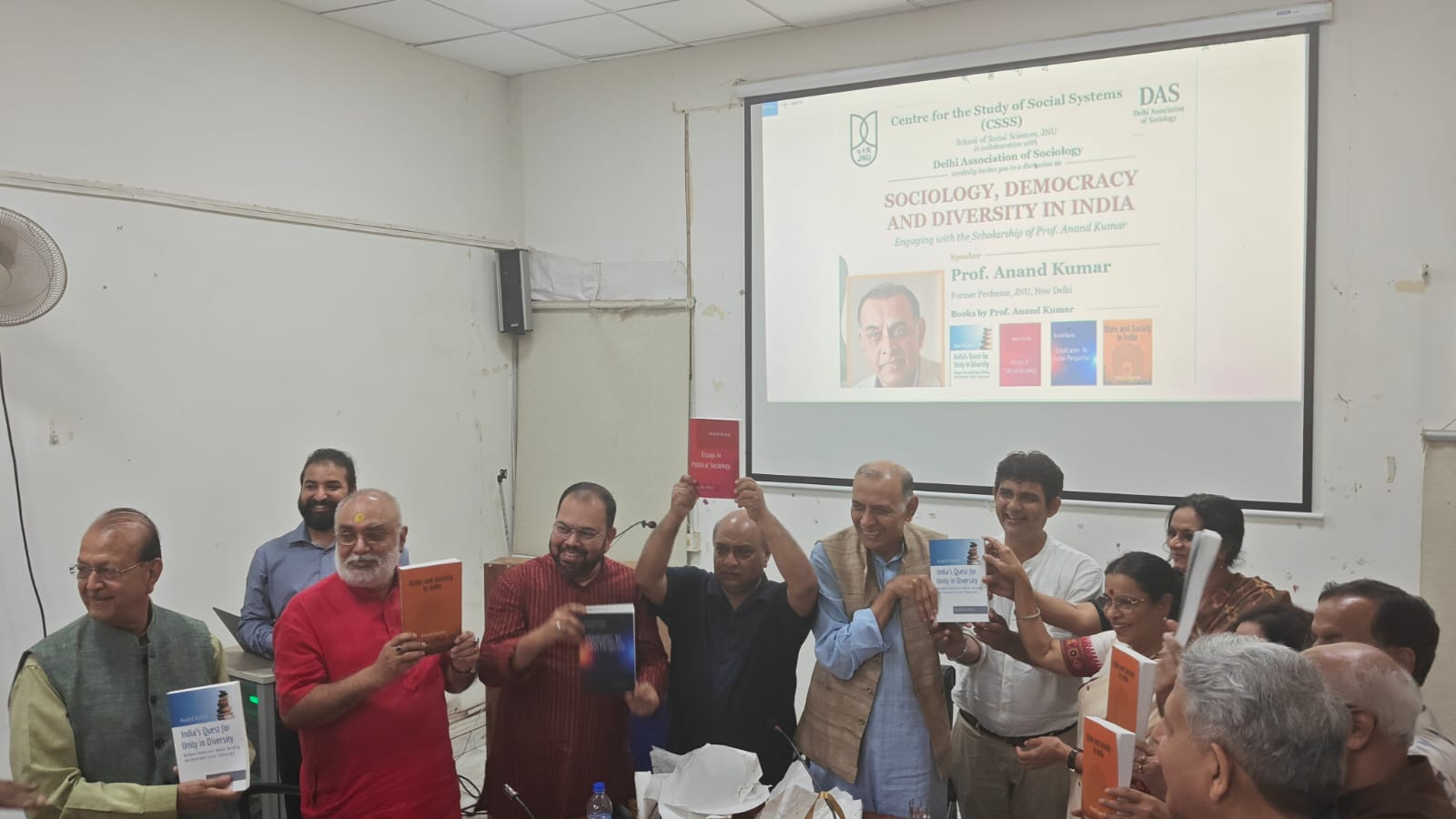
The four books by Prof. Anand Kumar—India’s Quest for Unity in Diversity, Essays in Political Sociology, Globalisation: An Indian Perspective, and State and Society in India, published by Readers Press, Delhi—collectively provide a significant sociological perspective on the complex relationship between society, democracy, state and diversity in contemporary India. Taken together, these works demonstrate that Indian democracy cannot be adequately understood merely through constitutional institutions, elections and formal political structures; it must also be examined through the social forces, historical experiences, identities and inequalities that shape political participation and state–society relations. The central concern emerging from Prof. Kumar’s scholarship is the continuing Indian quest to reconcile unity with diversity, democracy with social plurality, and state authority with the aspirations of different social groups. India’s diversity of caste, religion, language, region, ethnicity and cultural traditions is not treated simply as a problem of national integration, but as a fundamental sociological reality within which democratic institutions have evolved. In this perspective, unity becomes meaningful not through the suppression of differences but through their accommodation within a shared political and constitutional framework.
Prof. Kumar’s political sociology further directs attention to the relationship between power, participation and social change. Democracy is presented as a dynamic process in which institutions interact continuously with social movements, civil society, marginalized groups and changing patterns of political consciousness. The state, therefore, cannot be understood as an autonomous structure standing above society; its policies, institutions and practices are deeply connected with social interests, conflicts and negotiations. This state–society perspective is particularly important for understanding India, where democratic politics has brought historically excluded groups increasingly into the arena of representation and public action. At the same time, persistent inequalities of caste, class, gender, region and access to resources demonstrate that political democracy and social equality do not necessarily advance at the same pace. The sociological significance of democracy consequently lies in examining both its institutional achievements and the continuing struggles for substantive citizenship, dignity and inclusion.
The discussion of globalisation adds another important dimension to this framework. Prof. Kumar’s Indian perspective suggests that globalisation should not be viewed simply as an external economic process but as a multidimensional transformation affecting political institutions, social relations, identities, culture and the relationship between the state and citizens. India’s engagement with globalisation has simultaneously generated new opportunities, aspirations and forms of connectivity while producing questions concerning inequality, social security, cultural identity and the capacity of democratic institutions to respond to rapidly changing social conditions. The Indian experience thus requires an approach that connects global processes with historically specific social structures rather than assuming a uniform trajectory of modernisation.
Taken together, these four books reveal a distinctive sociological proposition: India’s democratic experience is inseparable from its diversity and from the continuing negotiation between state, society and citizen. Democracy survives and develops through institutional mechanisms, but its deeper foundations lie in social participation, accommodation of difference, public dialogue and the recognition of plural identities. Prof. Anand Kumar’s scholarship is therefore valuable not only for understanding Indian political sociology but also for appreciating the distinctive ways in which democracy is socially embedded in India. His work invites us to see unity in diversity not as a settled achievement but as an ongoing democratic project, continually reconstructed through the interaction of institutions, social groups, political movements and citizens. The release of these four volumes consequently provides an opportunity to recognise a sustained body of scholarship that places Indian society at the centre of the analysis of democracy, state power, diversity and social transformation.
Discover more from समता मार्ग
Subscribe to get the latest posts sent to your email.