A government job is highly sought after as it assures unbroken employment till retirement and pension after that till death do us part. Not only does the government pay well, it offers a completely removed lifestyle with assured housing, healthcare and education for the entire family. It’s a complete eco-system far removed from that of the nation it is meant to serve. Since entry is restricted and the stay is for the full lifetime, it’s as if it were complete gated nation.
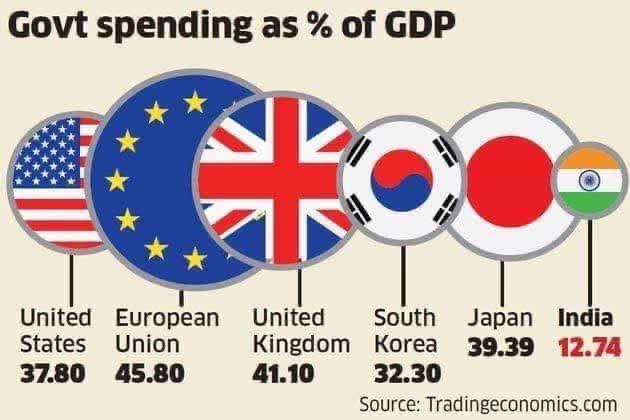
The three levels of government together employ about 185 lakh persons. The central government employs 34 lakhs, all the state governments together employ another 72.18 lakhs, quasi-government agencies account for a further 58.14 lakhs, and at the local government level, a tier with the most interface with the common citizens, we have only 20.53 lakhs employees. In other words it simply means we have five persons telling us to do this or do that, for every one supposedly serving us. And whom even these one out of six persons are answerable to is still a big question? Yet this public administration system accounts for 12.74% of the GDP now.
Do we then have a big government bearing down on us? Not really. Consider this: India has 1,622.8 government servants for every 100,000 citizens. In stark contrast, the U.S. has 7,681. The central government, with 3.1 million employees, thus has 257 serving every 100,000 population, against the U.S. federal government’s 840. Now look at the next tier at the state level. Bihar has just 457.60 per 100,000, Madhya Pradesh 826.47, Uttar Pradesh has 801.67, Orissa 1,191.97 and Chhattisgarh 1,174.62. This is not to suggest there is a causal link between poverty and low levels of public servants: Gujarat has just 826.47 per 100,000 and Punjab 1,263.34.
The troubled states or really speaking the troublesome states actually fare far better on this score. Thus, Mizoram has 3,950.27 public servants per the 100,000 population, Nagaland 3,920.62 and Jammu and Kashmir 3,585.96. Bar Sikkim, with 6,394.89 public servants per 100,000, no state comes close to international levels. Very clearly for the most part, India’s relatively backward states have low numbers of public servants. This means staff is not available for the provision of education, health and social services needed to address poverty.
During the past few years I have been traveling in the hinterlands of India. The biggest realization was that no sooner you get off the tarmac roads and highways, all signs of government disappear. Even the government primary schools when not locked, function mostly to provide the midday meals than any worthwhile education. There are very few signs of the police, irrigation, power and PWD departments. In most of the adivasi homelands the only presence of modern India is often the arrack contractor or the forest guard. Its as if a vast stateless nation exists.
Even in urban areas, the Prime Ministers call for a Swachch Bharat goes unheeded because the systems to collect trash, sewage and waste, and ensure their disposal just don’t exist. Does anybody wonder why Indians defecate everywhere? The PM’s call is timely, but to put it into effect we need the public systems that can carry away waste. This is why local government is critical.
Friedrich Engels prophesised that as societies develop “the interference of state power in social relations becomes superfluous in one sphere after another, and then ceases of itself. The state is not “abolished,” it withers away.” It would seem that the state has withered away in India without achieving any worthwhile social and economic transformation.
Mohan guruswami
Discover more from समता मार्ग
Subscribe to get the latest posts sent to your email.