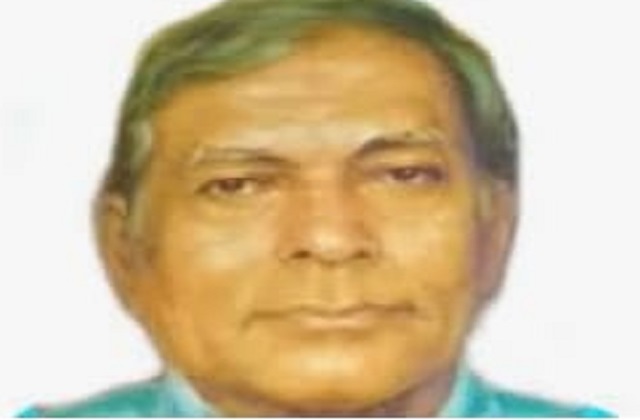
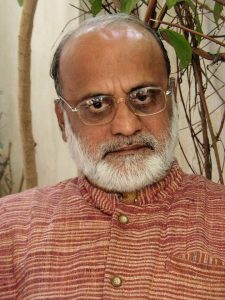
On the 86th birth anniversary of Kishan Patnaik, who upheld his life values without any compromise even in the face of adverse circumstances, I offer my humble tribute.
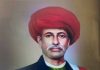
Kishan Patnaik (30 June 1930 – 27 September 2004) was an Indian social leader, socialist thinker, author, and activist. As a member of the 3rd Lok Sabha, he represented the Socialist Party from the Sambalpur constituency of India. He founded and edited the Hindi monthly periodical Samayik Varta.
Born on this very day, 30 June 1930, Kishanji’s birth centenary is due in 2030. Therefore, in the early phase of his life, at the age of 18 in 1948, while pursuing his college education, he got admission as a student in a college run by RSS people near the RSS headquarters in Nagpur.
It was during that time that Mahatma Gandhi’s assassination took place.
Last year, on 2 October 2025, the Rashtriya Swayamsevak Sangh celebrated its centenary with great fanfare across the country. In Nagpur, at least 50,000 people participated, including ambassadors from various countries and other prominent figures associated with the RSS.
This reminds me that Kishanji completed his graduation and post-graduation in Nagpur around the time of Mahatma Gandhi’s assassination. On 30 January 1948, in reaction to Gandhi’s killing, attacks took place in Nagpur on Maharashtrian Brahmins and RSS workers. The young Kishan felt that these attacks diluted the gravity of Gandhi’s assassination. However, because his college and its surrounding environment were steeped in RSS ideology, he became fed up. Irritated by this, he changed both his college and his subject — switching from English Literature to Political Science.
Even at that time, he had no deep acquaintance with any particular political ideology. Yet, even before turning twenty, he had developed a strong aversion to the deeply communal organisation Rashtriya Swayamsevak Sangh. This appears to be proof of his innate humanism.
He was not a secular fanatic either. He himself told me, “Whenever I am invited to speak from any platform, I go.” He gave two examples. One was when the RSS invited him to speak at Jhandewalan in Delhi, and he went. The second was when Pandurang Shastri Athavale, a spiritual leader who worked mainly among fishermen through the Swadhyay Parivar in the coastal belts of Gujarat and Maharashtra, invited him along with some retired army officers. Athavale’s work focused on de-addiction (alcohol, gutkha, etc.), digging wells for water, and planting trees. Thousands attended his discourses. Kishanji went without hesitation.
He told me, “Because we secularists tend to be somewhat dry in our speeches, fewer people connect with us. But Pandurang Shastri Athavale bases his discourses mainly on Lord Krishna and has achieved great success in his area — planting trees on a large scale, digging wells, and helping fishermen overcome addictions to alcohol, tobacco, beedi, and gutkha.”
When I asked him about caste and the communal atmosphere within the Swadhyay Parivar (this was in the late twentieth century, when Gujarat had not yet fully become a laboratory of Hindutva), he replied that it was a conducted tour. They only showed what the workers wanted them to see and did not give much opportunity to speak directly with local ordinary people.
I told him that figures like Pandurang Athavale, Dongre Maharaj, Asaram, Murari Bapu, Sudhanshu Maharaj, Ramdev Baba, Sri Sri Ravi Shankar, Dhirendra, and many other sadhus and sadhvis were also preparing the ground for RSS’s Hindutva ideology by influencing the minds of Bahujan society. Their approach lacks the humanistic vision of saints like Kabir, Basaveshwara, Tiruvalluvar, Guru Nanak Dev, Tukaram, Dnyaneshwar, Namdev, Eknath, Ravidas, Sri Narayana Guru, Mahatma Gandhi, Vinoba Bhave, J. Krishnamurti, and Ramana Maharshi.
In my personal experience, I have not seen another socialist of Kishan Patnaik’s calibre — a true “Kujat” (unconventional) socialist. Despite being one of the youngest members of the Lok Sabha (at age 32) from 1962 to 1967, he never accepted any of the facilities or privileges given to former MPs. He travelled across the country from one corner to another in third-class trains and buses. On top of that, as an asthma patient, how painful it must have been for him to travel in crowded conditions — I witnessed this myself during some journeys with him.
Among the national leaders of the Socialist Party, his relationship with Dr. Rammanohar Lohia began in his youth. He was closely associated with Lohia and even edited the English magazine Mankind and the Hindi magazine Jan, started by Lohia. He worked as his colleague. However, after the Indian independence movement, Kishanji continued to expand ideas of development at both the Indian and global levels, inspired by Lohia and Gandhi.
Until the end of his life, despite his failing health, he participated in movements against destructive development across the country. Later, I came to know him more closely as a thinker and writer, especially since the formation of the National Alliance of People’s Movements (NAPM) in 1994. He sometimes stayed at our residence in Kolkata. Most of our meetings happened at Narmada Bachao Andolan sites and various NAPM meetings all over India.
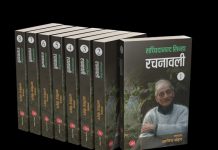
I observed that Kishanji was never under the influence of any leader. He was undoubtedly a democratic socialist, but I never saw him quoting any leader. As far as my observation goes, he was an independent thinker. This is clearly visible in his writings — from Vikalpahin Nahin Hai Duniya to Bharat Shudron Ka Hoga, and in his reflections on socialism, farmers’ issues, communalism, secularism, democracy, and sensitive subjects like gender relations.
In my life, besides Kishanji, I also had a close association with another senior thinker from West Bengal, Professor Amlan Dutta, former Vice-Chancellor of Visva-Bharati University, during my fifteen years in Kolkata. I can confidently say that in their early lives, figures like Dr. Rammanohar Lohia and Jayaprakash Narayan (for Kishanji), and M. N. Roy and Jayaprakash Narayan (for Amlan Dutta), played an important role in shaping their paths. However, according to the principle of historical relativity, after Lohia, no other socialist in India expanded socialist thought as much as Kishanji did. This is especially significant for me. In the writings of both these senior friends, one finds deep reflection on solving the economic, social, cultural, and especially developmental problems of our times.
After the Emergency, the 1977 “Bhanamati ka Kunba” (family of opportunists) was named the Janata Party. Among socialist leaders, Kishanji was the only one who not only opposed merging with the right-wing Jan Sangh — a party supported by capitalists and run on the RSS principle of “Ek Chalak Anuvart” (obedience to a single leader) — but also refused to join it. In the November 1989 Sambalpur Lok Sabha election in Odisha, Biju Patnaik, one of the founders of the Janata Party, offered him the Janata Party symbol. Kishanji declined and contested as an independent candidate. Had he accepted the symbol, he would have almost certainly returned to Parliament. He later wrote a very detached and neutral article about his defeat in that election. Except for his 1962–67 term, he could not return to the Lok Sabha.
In his personal life, he never compromised on his values, no matter what the cost. He was completely free of any showmanship. I observed that he ensured that even the slightest hint of any compromise did not emerge. During Lalu Prasad Yadav’s tenure as Chief Minister, the Bihar government used to honour non-Hindi writers who wrote in Hindi with an award. Kishanji and Medha Patkar were announced as recipients. Kishanji told me, “Because of my political differences with Lalu Prasad Yadav’s politics, I am not going to accept the award. But Medhaji should accept it. I am telling you this privately only so that no moral pressure falls on her. Please urge Medhaji to accept the award.” I was deeply moved by this sensitivity.
In my view, he was a much greater proponent of alternative politics than parliamentary politics. His book Vikalpahin Nahin Hai Duniya reflects both alternative development and alternative political thinking. In it, he wrote an essay titled Bailgadi Chahiye Ya Internet (Do We Need Bullock Carts or the Internet?). He had first presented these ideas in a speech at the Lok Vigyan Sammelan in Banaras. While having lunch together after the speech, he asked me, “Suresh, how did you like my speech?” I immediately replied, “You have thrown a stone at a beehive. I am inviting you to Nagpur to discuss this topic in detail. You will have to stay in Nagpur for at least three days just for this.” He came to Nagpur shortly after Banaras. That event remains one of the best programmes of my life. Kishanji shed extensive light on the growing impact of modern technology. The discussions that followed were excellent.
However, it pains me greatly to recall that the notes, papers, and some books from that excellent programme were destroyed when rainwater entered our house and ruined our old collection of magazines and books. Remembering this still saddens me.
Today, with debates on AI technology raging across the world, Kishan Patnaik’s thoughts come to mind even more strongly.
Finally, when our Shantiniketan friend Manisha Banerjee asked him during the current political and cultural decline, “What should be our role?”, he replied, “To protect our life values without any compromise is entirely in our own hands. Therefore, we must safeguard them in all circumstances.”
There is a beautiful abhang by the Marathi saint Tukaram Maharaj: “Bole Taisa Chale Tyachi Vandavi Paule” (Salute the feet of the one whose words and deeds are in harmony).
Humble tribute to the memory of Kishan Patnaik, the finest “Kujat” socialist I have met in my life.
Discover more from समता मार्ग
Subscribe to get the latest posts sent to your email.